
How the Proposed USA–Uganda Health Data Sharing Agreement Threatens Privacy Rights

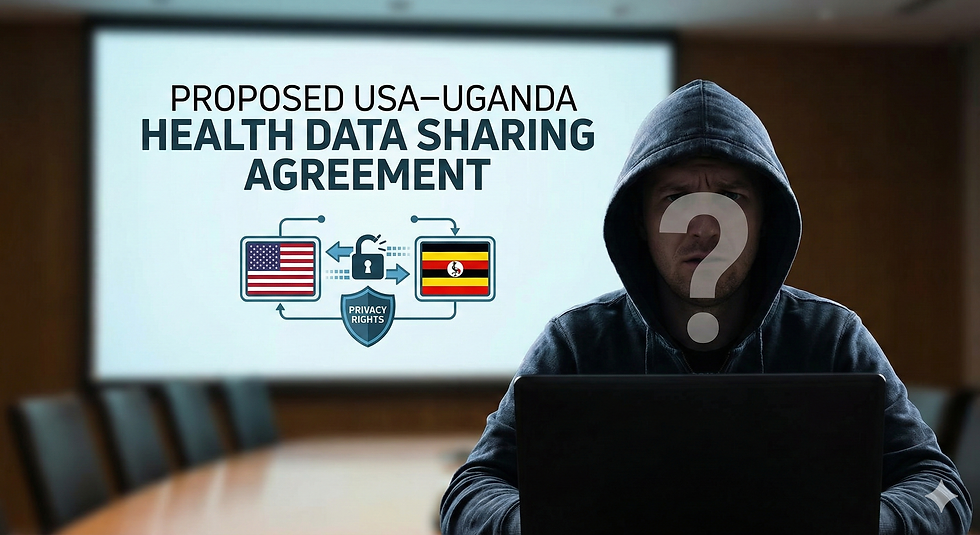
Overview of the Proposed Agreement
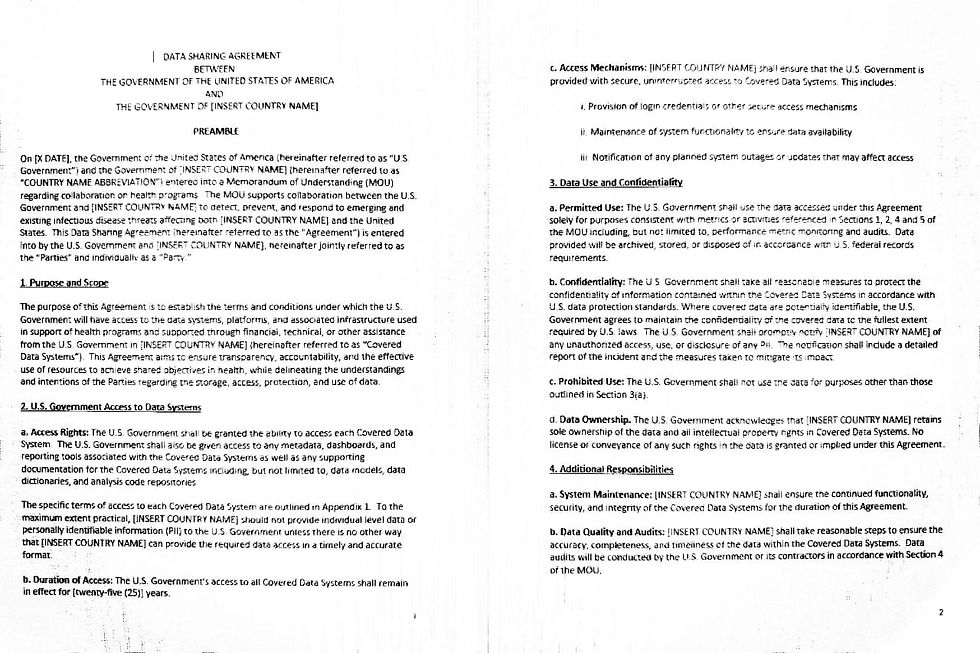
The agreement establishes a framework under which the U.S. Government would gain extensive access to Uganda’s health data systems, referred to as “Covered Data Systems.” These include platforms, tools, dashboards, analytics models, and repositories supported with U.S. funding or technical assistance.
The U.S. Government would be granted:
Access to metadata, dashboards, analytical tools, system documentation, and data dictionaries.
Rights to view and analyze performance metrics and health program data.
25 years of uninterrupted access unless otherwise terminated.
While framed as a collaboration to improve disease surveillance and health program evaluation, the broad scope of access raised several concerns.
2. Data Privacy Risks
a. Broad and Vague Access Rights
The agreement allows the U.S. Government to access “any supporting documentation,” including data models and analytic repositories.
The agreement does not clearly distinguish between non-personal, de-identified, and personally identifiable health data a major compliance gap.
b. Confidentiality Clauses Are U.S.-Law Centric
The confidentiality obligations reference compliance with U.S. federal laws, rather than Uganda’s own PDPA. This creates:
A jurisdictional conflict, where U.S. standards override local protections.
Weaknesses in enforcement, since breaches handled under U.S. law may not provide remedies for Ugandan data subjects.
Join the discussion today on X (formerly Twitter) https://x.com/i/spaces/1gqxvrpajpWxB?s=20

3. Data Sovereignty Concerns
One of the core issues raised was the imbalance in control Uganda “retains ownership of the data,” but the U.S. Government maintains exclusive access and determines how the data is stored, archived, and disposed of under U.S. federal record policies. This effectively shifts operational control to a foreign government.
4. Potential for Misuse and Secondary Use
The agreement states that data accessed will be used only for purposes consistent with the MOU. However “Consistent with the MOU” is broad and includes monitoring, evaluation, and performance assessments, which could expand over time. No explicit prohibition exists against secondary use by third parties, analysts, or partner agencies.
The prohibition clause also lacks specificity, leaving room for interpretation.
5. Long Duration and Uninterrupted Access
The agreement provides the U.S. Government with access for 25 years, longer than the operational lifespan of many digital health systems.
6. Lack of Independent Auditing and Oversight
While Uganda must ensure accuracy and system integrity, the audits will be conducted by the U.S. Government or its contractors. This raises issues of:
Transparency
Conflict of interest
Limited accountability to Ugandan regulators or citizens
Uganda’s Data Protection Office (PDPO) is not explicitly assigned an oversight role, an omission that directly contradicts national law.
7. Implications for Public Trust
Health data is among the most sensitive categories of personal data.
Public trust in health systems depends on transparency and local control.
Agreements that transfer data access to foreign governments risk undermining public confidence.
Communities might become reluctant to share vital health information, affecting Uganda’s broader health outcomes.
8. Possible Recommendations
✔ 1. Insert explicit PDPA compliance language
The agreement must state that all processing is subject to Uganda’s Personal Data Protection Act and oversight by the PDPO.
✔ 2. Narrow the scope of accessible data
Clarify what data is anonymized, aggregated, or excluded entirely.
✔ 3. Limit the duration of access
25 years is excessive and should be reviewed at shorter intervals.
✔ 4. Establish joint audit mechanisms
Uganda must have equal oversight rights and independent auditing capacity.
✔ 5. Ensure data minimization and purpose limitation
Uses should be strictly defined and enforceable.
✔ 6. Strengthen breach notification procedures
The current language requires notification but does not outline timelines, remedies, or responsibilities.
Conclusion
The proposed USA–Uganda Health Data Sharing Agreement presents legitimate opportunities for improved disease surveillance and health system performance. However, the risks to privacy, sovereignty, and public trust are substantial and cannot be ignored.
Any agreement involving sensitive health data must be grounded in:
Clear legal safeguards
Strong oversight
Local control
Transparent engagement with the public
Uganda stands at an inflection point. A well-negotiated agreement can strengthen health cooperation. A weak one could compromise the digital rights of millions for decades.
Read the full agreement


.jpg)

Comments