
A claim for unjust enrichment does not require the existence of a contract. What matters is that, money was received, no corresponding benefit was provided, and retention of the money was unjust.

🏛️ Facts
The Plaintiff, Craig Whitehead, and the 1st Defendant, Buhikire Benjamin, along with a third party, incorporated a company in Uganda called Alexander and Renae Holding East Africa Limited on February 1, 2022. The 2nd Defendant, Simon Gombekwa, was the Company Secretary.
The Plaintiff, who was the financier, sent a total of USD 62,937 (later claimed as USD 66,887 in submissions) to the Defendants for the sole purpose of meeting the Company's objectives, including purchasing land and setting up businesses in Uganda. The Defendants were to manage the operations in Uganda in exchange for a stake or remuneration.
The Plaintiff alleged that the Defendants misappropriated the funds for their own use, failed to provide accountability, property documents, or proof of investment, and refused to refund the money despite a formal demand notice.
The Defendants denied the allegations, claimed the matter lacked territorial jurisdiction because the transaction allegedly arose in the USA, and denied ever receiving money from the Plaintiff or contracting with him. They also contended the Company never carried out business due to economic hardships.
After repeated demands (including WhatsApp messages from 2022–2023 and a formal demand notice dated 12 March 2024), the Defendants neither accounted for nor refunded the money.
The Defendants filed a defence but repeatedly failed to appear in court, failed to file witness statements or a trial bundle, and abandoned a threatened preliminary objection on jurisdiction. The suit therefore proceeded ex parte.
⚖️ Issues
The Court determined the following issues:
Whether the High Court of Uganda had the territorial jurisdiction to hear the matter.
Whether the Plaintiff had a cause of action against the Defendants.
Whether the Defendants unjustly enriched themselves from the Plaintiff's money.
What remedies were available to the parties.
👨💼 Submissions (Plaintiff's)
Learned Counsel for the Plaintiff argued the Defendants unjustly enriched themselves, relying on the elements of a claim for "money had and received":
Receipt of Money Without Benefit, Evidence, including WhatsApp messages (PEX 3, PEX 4), a summary of transactions (PEX 5), and the Company search report (PEX 1), proved the Defendants received the funds (USD 57,887 via Cash App and USD 9,000 cash) for investment purposes but failed to provide documentation for purported land purchases or proof of the alleged concrete block and culvert business.
No Return of Money, The Defendants refused to refund the money despite a demand notice (PEX 6).
Unjust Retention, The Defendants failed to provide proof of projects or a legitimate reason for retaining the funds, making their retention unjust.
The Defendants did not appear at the substantive hearing, and the Plaintiff's submissions went uncontroverted.
Filed a joint written statement of defence denying receipt of money and raising jurisdiction, but took no further steps and did not appear at the hearing → no oral or documentary evidence tendered.
👩⚖️ Legal Representation
Plaintiff, Learned Counsel Fahim Matovu of M/s Katende, Ssempebwa and Company Advocates, Solicitors and Legal Consultants.
Defendants, M/s Mujurizi & Tumwesigye Advocates (though the Defendants and their Counsel repeatedly failed to appear for substantive proceedings).
🧑⚖️ Court's Findings
Preliminary Objections
On Jurisdiction
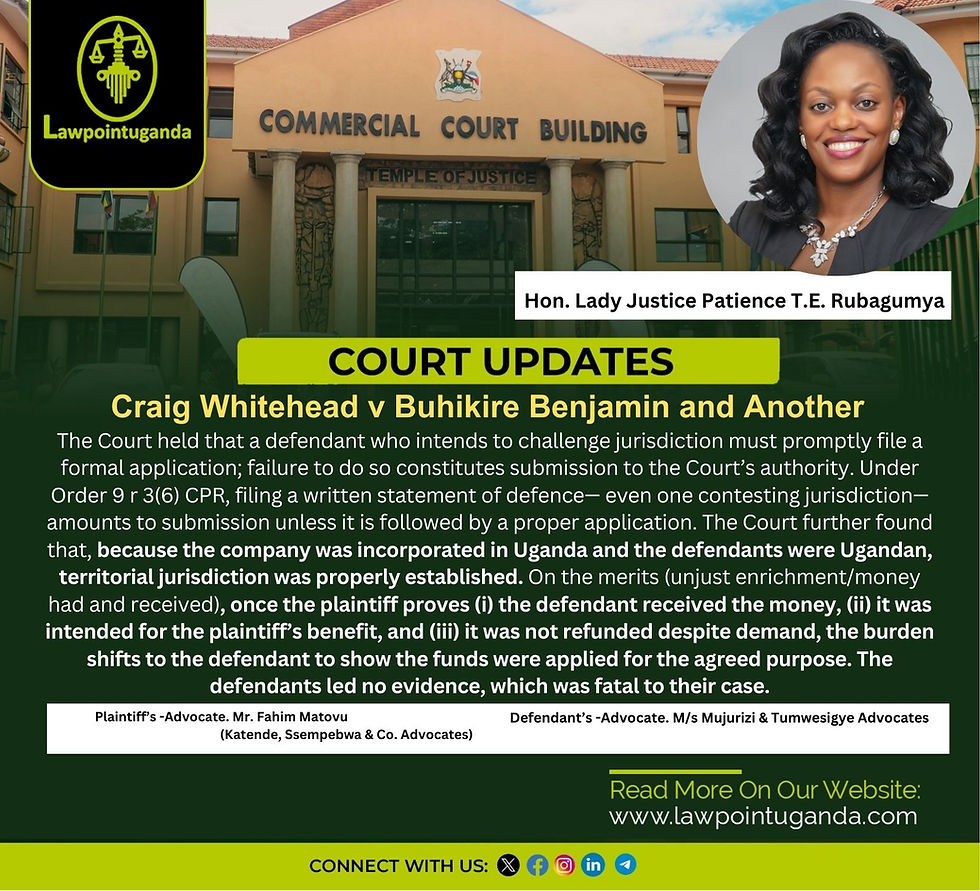
The Court found that by filing a Written Statement of Defence (WSD), even while raising an objection to jurisdiction, and by failing to file a formal application as directed, the Defendants submitted to the jurisdiction of the Court, as per Order 9 rule 3(6) of the Civil Procedure Rules. Furthermore, the Company was incorporated in Uganda, and the Defendants are Ugandans.
The Court noted that by filing a defence but failing to pursue their objection, the Defendants “submitted to the jurisdiction of this Court.”
As such the Objection failed.
On the Cause of Action
The Court found that the Plaint disclosed a cause of action for money had and received as the Plaintiff sought recovery of money allegedly sent to the Defendants for investment but which they used for their own benefit. The Plaintiff enjoyed a right, which was violated by the Defendants, since the Plaintiff alleged:
He had a right to the money;
The Defendants violated that right by diverting it;
The Defendants are liable to refund it.
The Objection failed.
Unjust Enrichment
The Court proceeded ex parte (without the Defendants) and held that the Plaintiff established a prima facie case for a claim of "money had and received" (unjust enrichment) by proving:
Receipt of Money: The Defendants received the money for the intended purpose of setting up businesses for the Company, Alexander and Renae Holding East Africa Limited.
No Benefit Provided: The Defendants failed to provide documentary evidence or proof that the money was used as intended or for the Plaintiff's benefit (e.g., land titles, business documents).
No Refund: The Defendants failed to refund the money upon demand.
The Court held that the Defendants failed to controvert the Plaintiff’s prima facie case, and the evidential burden was not discharged.
The court held that;
“Once the Plaintiff makes out a prima facie case in his favour, the evidential burden shifts to the Defendant to controvert the Plaintiff’s prima facie case; otherwise, judgment must be entered in favour of the Plaintiff. The Defendants, having failed to controvert the Plaintiff’s prima facie case, I, therefore, find that they unjustly enriched themselves from PW1’s money.”
“From the above analysis… it is undisputed that the Defendants received money from the Plaintiff. This money was intended to start up the Companies, and help in the purchase of land and machinery… However… the Defendants have failed to adduce any evidence… to prove that the Plaintiff’s money was used as intended…”
On the shift of the evidential burden, the Court stated:
"It was held in the case of Gloria Kubajo and Oloye Venance Kolley Vs Francis Drate (supra) and Uganda Farmers Meat Co. Limited Vs Fresh Cuts Uganda Ltd (supra) that the burden of proving that equity and good conscience does not demand a refund devolves upon the Defendant who offers such a defence to the claim of the creditor. That it is settled law that once the Plaintiff makes out a prima facie case in his favour, the evidential burden shifts to the Defendant to controvert the Plaintiff’s prima facie case; otherwise, judgment must be entered in favour of the Plaintiff."
And in conclusion on the issue of unjust enrichment:
"The Defendants, having failed to controvert the Plaintiff’s prima facie case, I, therefore, find that they unjustly enriched themselves from PW1’s money."
What remedies are available to the parties?
The Plaintiff sought a declaration of unjust enrichment, a refund of USD 62,937, general damages, interest, and costs. Having already found that the Defendants unjustly enriched themselves by receiving the Plaintiff’s funds and diverting them to personal use, the Court proceeded as follows:
1. Refund of USD 62,937 (Restitution)
Relying on Joseph Jabs Mubiru v. Quillino Bamwine, the Court reaffirmed that the primary remedy for unjust enrichment is restitution, intended to restore to the Plaintiff the value wrongfully retained by the Defendants.Since liability had been established under Issue No. 1, the Court ordered the Defendants to refund USD 62,937 to the Plaintiff.
2. General Damages
The Plaintiff led evidence of financial loss, inconvenience, and suffering resulting from the Defendants’ misuse of the investment funds. Guided by authorities including:
Kabandize John Baptist & 21 Others v. KCCA (C.A.C.A 36/2016),
Takiya Kashwahiri & Anor v. Kajungu Denis (C.A.C.A 85/2011), and
UCB v. Deo Kigozi [2002] 1 EA 305,the Court held that general damages are compensatory and intended to place the Plaintiff, as far as money can do, in the position they would have been in absent the wrong.The Court awarded UGX 30,000,000 as general damages.
3. Interest
Under Section 26(2) of the Civil Procedure Act and guided by Milly Masembe v. SCOUL and Mohanlal Kakubhai Radia v. Warid Telecom, the Court granted interest as follows:
18% p.a. on the decretal sum (USD 62,937) from 22 November 2023 until payment in full.
6% p.a. on the general damages from the date of judgment until payment in full.
4. Costs
Applying Section 27(2) CPA and Uganda Development Bank v. Muganga Construction Co. Ltd, the Court awarded the Plaintiff costs of the suit, noting that the Plaintiff had succeeded in the main purpose of the action.
🔑 Holding
The Court held that the Defendants unjustly enriched themselves with the Plaintiff’s money and are liable to refund it.
The Court entered judgment ex parte in favor of the Plaintiff.
Final Orders
The Court entered judgment for the Plaintiff and ordered:
A declaration that the Defendants unjustly enriched themselves by receiving and misusing USD 62,937.
Refund of the USD 62,937 to the Plaintiff.
Payment of UGX 30,000,000 as general damages.
Interest at 18% p.a. on the refund from 22 November 2023 until full payment.
Interest at 6% p.a. on general damages from the date of judgment until full payment.
Costs awarded to the Plaintiff.
7. KEY TAKEAWAYS
1. Filing a Defence = Submission to Jurisdiction
Even when defendants intend to challenge jurisdiction, failure to promptly file the application results in submission to the Court’s authority.
2. Persistent Absenteeism Leads to Ex Parte Proceedings
Repeated failure to attend scheduling and hearings justified proceeding ex parte.
3. WhatsApp Messages Are Valid Evidence
The Court reaffirmed modern evidentiary standards allowing WhatsApp and electronic communication as proof of transactions and agreements.
4. Unjust Enrichment Requires No Contract
A formal contract is unnecessary. What matters is that:
Money was received,
No benefit was provided,
Retention is unjust.
5. Burden Shifts to the Defendant After Prima Facie Proof
Once a plaintiff shows funds were sent and not accounted for, the defendant must rebut — silence is fatal.
6. Evidence of Accountability is Crucial
Failure to provide receipts, land documentation, business activity records, or transaction traceability strongly supports unjust enrichment claims.
Read more


.jpg)

Comments