
High Court Rules That Delivery and Acceptance of Goods May Constitute Sufficient Performance to Render an Oral Contract Enforceable Despite a Statutory Requirement for Writing

Background Facts
The plaintiff, CEVA Santé Animale, a French company engaged in the animal health sector, instituted a suit against MTK Uganda Limited seeking recovery of USD 175,018.85 being the outstanding balance for veterinary products supplied on credit.
The plaintiff contended that in November 2018, the parties entered into a verbal arrangement under which the defendant would place orders for veterinary drugs and related products. Upon delivery, the plaintiff would issue invoices payable within the periods stipulated therein.
According to the plaintiff, goods were supplied pursuant to several proforma invoices, invoices, and bills of lading. Although the defendant made partial payments, its last payment was made on 13 September 2019, leaving an unpaid balance of USD 175,018.85 together with contractual interest.
The defendant admitted receiving the products but maintained that there was no formal distributorship agreement after the expiry of an earlier distributorship arrangement in 2014. It asserted that the goods had been imported specifically for a Government trypanosomiasis control project and that after the plaintiff established another company in Uganda, the defendant's manufacturer's authorisation was revoked, rendering it unable to supply the products to the Government. The defendant alleged that most of the products subsequently expired, causing loss.
Issues for Determination
The Court framed the following issues:
Whether the defendant was indebted to the plaintiff in the sum of USD 175,018.85.
What remedies were available to the parties.
Legal Representation
The plaintiff was represented by M/s MAKKS Advocates, while the defendant was represented by Mr. Kiwunda Mathew of M/s Muwema & Co. Advocates and Solicitors. The court noted that defence counsel indicated he had lost touch with the client and was therefore unable to present evidence in defence of the suit, an explanation the court found unsatisfactory given that directions to file a defence trial bundle and witness statements had been issued nearly a year earlier, on 13 September 2022. The court accordingly invoked Order 17 Rule 4 of the Civil Procedure Rules and closed the defence case.
Submissions of the Parties
Plaintiff's submissions
Counsel for the plaintiff submitted that although the agreement was oral and the value of the goods exceeded UGX 500,000, which would ordinarily have required a written contract under section 10(5) of the Contracts Act, the agreement was nonetheless enforceable on two grounds.
First, counsel submitted that the commercial documents evidencing the supply of goods were sufficient to prove the existence of the agreement. Second, counsel submitted that delivery of the goods and acceptance by the defendant amounted to performance of a contract of sale, which constituted a sufficient substitute for the writing otherwise required. Counsel further submitted that the defendant had failed and/or neglected to settle its payment obligation despite having received the goods.
Defendant's position
The defendant filed no witness statements and adduced no evidence. Its written defence had maintained that the plaintiff was responsible for the loss, having established Veribrand (U) Ltd to take over activities previously undertaken by the defendant, thereby precipitating the revocation of the defendant's manufacturer's authorisation and the consequent inability to supply the Government project. The defendant contended that the expired products represented a loss that fell on the plaintiff.
Court's Findings
On the existence of a contract
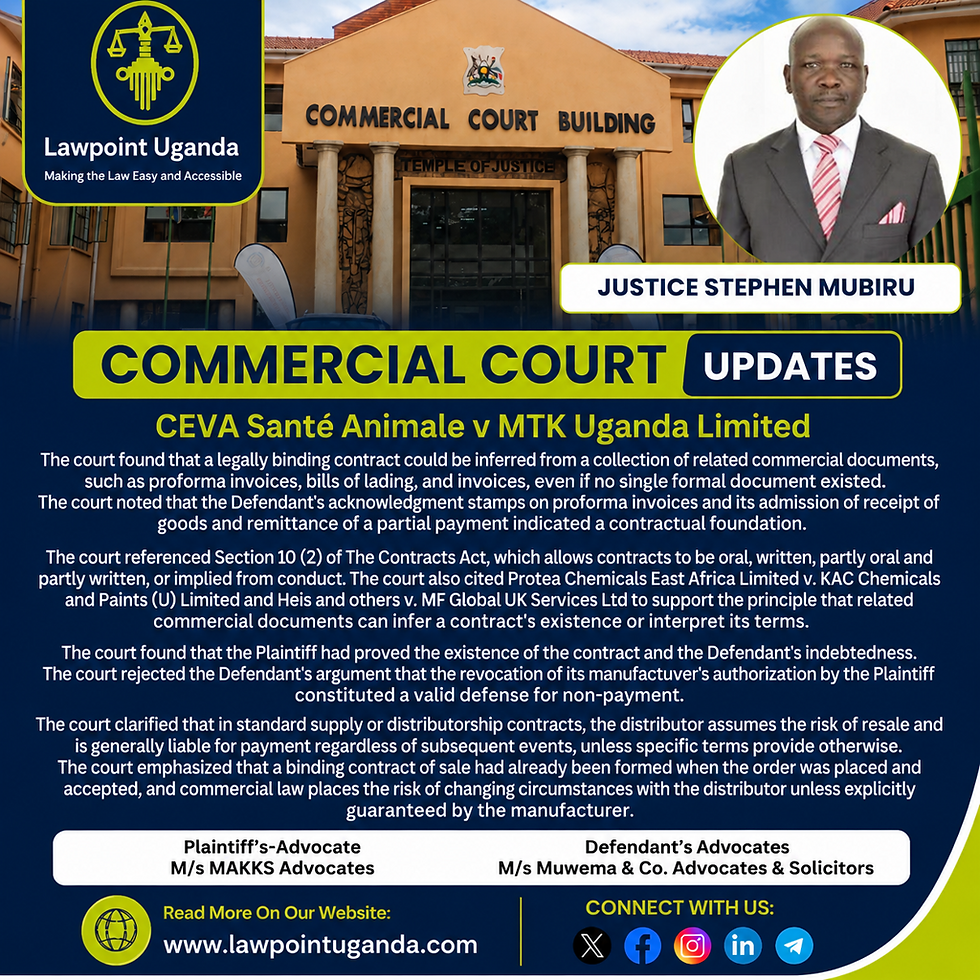
The court found that a legally binding contract could be inferred from a collection of related commercial documents, such as proforma invoices, bills of lading, and invoices, even if no single formal document existed. The court noted that the Defendant's acknowledgment stamps on proforma invoices and its admission of receiving goods and remitting partial payment indicated a contractual foundation. The court referenced Section 10 (2) of The Contracts Act, which allows contracts to be oral, written, partly oral and partly written, or implied from conduct. The court also cited Protea Chemicals East Africa Limited v. KAC Chemicals and Paints (U) Limited and Heis and others v. MF Global UK Services Ltd to support the principle that related commercial documents can infer a contract's existence or interpret its terms.
On the Defendant's indebtedness
The court found that the Plaintiff had proved the existence of the contract and the Defendant's indebtedness. The court reiterated that the burden of proof for payment rests on the party alleging payment, citing J.K. Patel v. Spear Motors Ltd. The court noted that the Defendant did not provide evidence to refute the Plaintiff's claims and, to the contrary, acknowledged the debt and committed to payment via email correspondences (exhibits P.Ex.7 to P.Ex.9). The court therefore concluded that the Defendant owed the Plaintiff US $175,018.85.
On the Defendant's defense regarding the manufacturer's authorization
The court rejected the Defendant's argument that the revocation of its manufacturer's authorization by the Plaintiff constituted a valid defense for non-payment. The court clarified that in standard supply or distributorship contracts, the distributor assumes the risk of resale and is generally liable for payment regardless of subsequent events, unless specific terms provide otherwise. The court cited Translink Limited v. Chemi & Cotex Industries Limited, Tanzania (CCIL). The court emphasized that a binding contract of sale had already been formed when the order was placed and accepted, and commercial law places the risk of changing circumstances with the distributor unless explicitly guaranteed by the manufacturer.
On remedies
The court awarded the Plaintiff the outstanding sum of US $175,018.85 as a liquidated claim, noting that such claims must be specifically pleaded and strictly proved, referencing Borham-Carter v. Hyde Park Hotel and Masaka Municipal Council v. Semogerere.
The court awarded interest at the contractual rate of 10.11% per annum from the date of filing the suit (August 27, 2021) until full payment. The court cited Section 26 (2) of The Civil Procedure Act, which empowers courts to award reasonable interest. The court also referenced Carmichael v. Caledonian Railway Co. and Mohanlal Kakubhai Radia v. Warid Telecom Ltd on the principle that interest is awarded when money is wrongfully withheld.
The court rejected the claim for general damages, stating that an award of interest in commercial disputes serves the same purpose as compensation for the loss of return opportunity. The court referenced Section 60 (1) of The Contracts Act regarding compensation for breach of contract and cases like Hadley v. Baxendale. The court found that an additional award of general damages would lead to overcompensation.
The court awarded costs of the suit to the Plaintiff, in line with the general rule under Section 27 (2) of The Civil Procedure Act that costs follow the event, and found no special reasons to deviate from this rule.
Holding
The court entered judgment for the Plaintiff against the Defendant, ordering;
A sum of US $175,018.85 as the outstanding amount.
Interest thereon at the contractual rate of 10.11% per annum from August 27, 2021, until payment in full.
The costs of the suit.
Read the full case
Key Takeaways
A binding contract need not be contained in a single signed instrument. Courts will read proforma invoices, bills of lading, and related documents together to determine whether the necessary contractual elements are present.
Even where a contract was required to be in writing under section 10(5) of the Contracts Act, delivery and acceptance of goods can constitute sufficient performance to render an oral agreement enforceable.
In the absence of explicit conditional purchase or consignment clauses, a distributor cannot withhold payment from a manufacturer merely because the contemplated end-use, such as a government tender, subsequently falls through.
Revocation of a licence after contract formation does not discharge the payment obligation. Once a binding order has been placed and accepted, the distributor remains liable for payment. The risk of subsequent regulatory or commercial changes rests with the distributor unless the contract explicitly provides otherwise.
Where the court awards interest at a contractual or commercial rate, a concurrent award of general damages for delayed payment risks overcompensation and will generally be refused.
A defendant who fails to file witness statements and adduces no evidence will face closure of their case under Order 17 rule 4 CPR, leaving the plaintiff's uncontested evidence to establish the claim.


.jpg)

Comments