
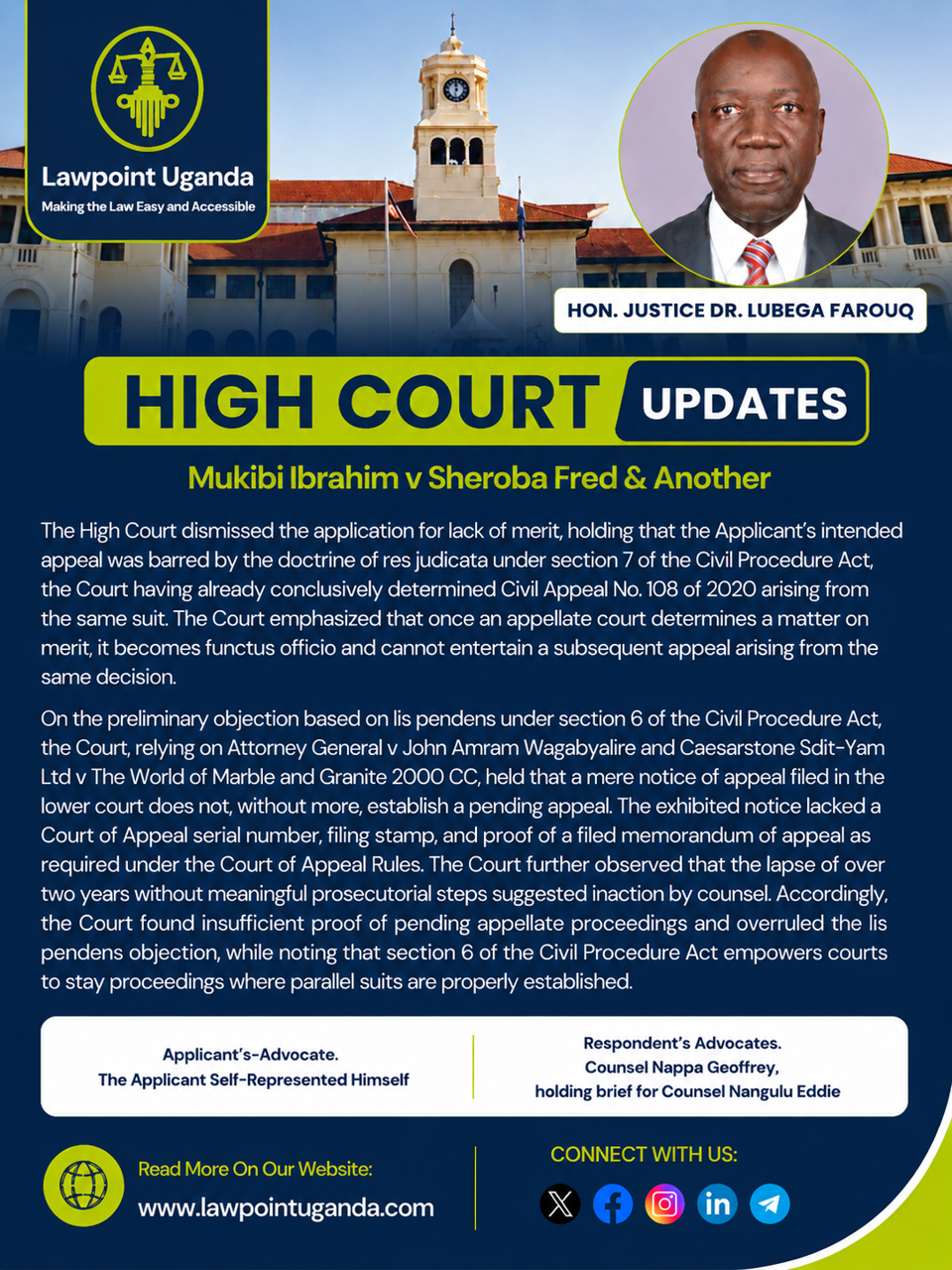
A mere notice of appeal filed in the lower court, without evidence of filing in the appellate court (serial number, stamp, memorandum), may not successfully ground a lis pendens objection. Court Rules

Facts
The dispute concerned land located at Nabweya Top Village, Nabweya Parish, Namanyonyi Sub-County, Mbale District. The Applicant (Mukibi Ibrahim) claimed to be the successful party in Civil Suit No. 051 of 2020 at Mbale Chief Magistrates Court, where the trial court ordered the 1st Respondent to hand over half of the suit land (described as 120 ft by 138 ft) to him. The court, however, decreed a portion measuring 60 ft by 69 ft (which the Applicant argues equals only a quarter of the total land).
On 3 September 2018, the 1st Respondent (Sheroba Fred) executed a land sale agreement with the 2nd Respondent (Wanjusi Philip) for UGX 12,000,000/=, with an initial deposit of UGX 6,000,000/= paid.
On 8 September 2018, the 2nd Respondent entered a Memorandum of Understanding with the Applicant (Mukibi Ibrahim) to jointly purchase an additional portion of the same land, to be held as tenants in common. The 1st Respondent declined the joint purchase offer. The 2nd Respondent also defaulted on the balance payment, leading to rescission of the original agreement.
On 2 October 2020, the Applicant filed Civil Suit No. 51 of 2020 against both Respondents seeking specific performance of the land sale agreement dated 3 September 2018. On 29 October 2021, the trial Magistrate delivered judgment in favour of the Applicant, finding that the 1st Respondent had sold a portion of the suit land measuring 60 ft x 69 ft to the 2nd Respondent, which was decreed to the Applicant.
The Respondents appealed via Civil Appeal No. 108 of 2020 (High Court), which was dismissed on 14 February 2024; the High Court upheld the lower court's decision. The Applicant alleged that the trial court's calculation of 60 ft x 69 ft (= a quarter of 120 ft x 138 ft) was a mathematical error. The court had ordered that 'half' of the suit land be handed over, yet the measurement reflects only one-quarter. The Applicant filed Misc. Application No. 47 of 2024 in the High Court to correct the error under the slip rule was dismissed on the grounds that the trial court had jurisdiction.
The Applicant then filed Misc. Application No. 19 of 2024 in the trial court. The Magistrate advised him to appeal instead. The Applicant later withdrew this application. The Applicant then sought leave to appeal out of time from the Magistrate's judgment and an extension of time to file the appeal in the High Court.
The Central Issues before the court were;
Whether the application was barred by the doctrine of lis pendens (Section 6, Civil Procedure Act).
Whether the intended appeal was barred by res judicata (Section 7, Civil Procedure Act).
Whether the Applicant should be granted leave to appeal out of time and extension of time (Order 51 Rule 6 & Order 52, Civil Procedure Rules).
Legal Representation
Applicant: Represented himself (in person).
Respondents: Represented by Counsel Nappa Geoffrey (holding brief for Counsel Nangulu Eddie).
The matter was determined by way of written submissions.
Submissions by the Applicant (Self-Represented) submitted that;
After judgment in Civil Suit No. 51 of 2020, the Respondents filed Civil Appeal No. 108 of 2021 challenging the judgment in whole, which was dismissed by the High Court.
That he thereafter filed Misc. Application No. 47 of 2024 in the High Court to correct the mathematical error under the slip rule. The High Court directed him to the trial court.
He then filed Misc. Application No. 19 of 2024 at the Magistrate's Court. The trial Magistrate advised him to file an appeal instead, noting the error appeared repeatedly and was therefore intentional.
He maintained that he won at both the trial level and on appeal, and only seeks to rectify the measurement discrepancy; 60 ft x 69 ft represents a quarter, not half of 120 ft x 138 ft, contrary to the court's order.
He challenged the claim of a pending Court of Appeal case, arguing that a Notice of Appeal is not proof of an actual appeal; only a memorandum of appeal would constitute a live appeal. No memorandum or appeal number was produced.
Submissions by Counsel for the Respondents
Counsel raised two preliminary objections and submitted on the law governing the extension of time:;
The instant application is barred under Section 6 of the Civil Procedure Act because the Respondents have already filed proceedings in the Court of Appeal involving the same parties and subject matter.
That the intended appeal is barred under Section 7 of the Civil Procedure Act, as the High Court has already heard and determined Civil Appeal No. 108 of 2020 on merit between the same parties.
Citing the decision in Degeya Trading Stores (U) Ltd v. Uganda Revenue Authority, Court of Appeal No. 16 of 1996, for the proposition that an applicant for leave to appeal out of time must demonstrate either (a) reasonable chances of success or (b) arguable grounds and no dilatory conduct.
Submitted that the application is an afterthought and the Applicant has failed to demonstrate a likelihood of success on appeal.
Court’s Findings
1. On Lis Pendens
The Court examined section 6 of the Civil Procedure Act and considered the decision in Attorney General v John Amram Wagabyalire, which relied on the South African case of Caesarstone Sdit-Yam Ltd v The World of Marble and Granite 2000 CC.
The Court held that the Respondents had failed to prove the existence of a pending appeal before the Court of Appeal because;
The annexed notice of appeal bore no Court of Appeal serial number;
There was no Court of Appeal stamp confirming filing;
No memorandum of appeal had been produced;
More than two years had elapsed without any meaningful step taken to prosecute the alleged appeal.
The Court observed that under Rule 10(3) of the Judicature (Court of Appeal Rules) Directions, a serial number is allotted upon institution of appellate proceedings, and the absence of such indication cast doubt on whether an appeal had actually been lodged.
Justice Lubega Farouq further noted that delays of over two years in obtaining certified proceedings are uncommon and suggested lack of diligence by counsel.
Accordingly, the Court overruled the preliminary objection based on lis pendens.
2. On Res Judicata
The Court then turned to section 7 of the Civil Procedure Act and relied on Ayuga v Doka, which explains that a plea of res judicata is established by examining the pleadings and judgment in the earlier suit. The Court found that Civil Appeal No. 108 of 2020 had already been heard and conclusively determined by the High Court; The intended appeal sought to challenge the same judgment arising from Civil Suit No. 051 of 2020; the High Court had already exercised its appellate jurisdiction over the dispute.
The Court therefore held that entertaining another appeal arising from the same suit would offend the doctrine of res judicata and render the Court functus officio.
The second preliminary objection was upheld.
Holding
The High Court dismissed the application with costs to the Respondents.
The Court held that the Applicant’s intended appeal was barred by the doctrine of res judicata because the High Court had already determined Civil Appeal No. 108 of 2020 arising from the same suit; and the Court was functus officio and could not entertain another appeal arising from the same decision.
Although the Court rejected the objection based on lis pendens, the success of the res judicata objection disposed of the entire application.
Read the full case below
Key Takeaways
1. A Notice of Appeal Alone Does Not Necessarily Prove a Pending Appeal
The Court clarified that merely filing a notice of appeal is insufficient to establish the existence of active appellate proceedings. Evidence such as:
a. A Court of Appeal serial number,
b. Filing stamp, and
c. Memorandum of appeal
may be necessary to demonstrate that an appeal is properly instituted.
2. Courts Will Scrutinize Delay and Counsel Conduct in Appellate Proceedings
The Court emphasized that unexplained delays in prosecuting appellate processes may indicate lack of diligence by counsel and weaken reliance on procedural doctrines such as lis pendens.
3. Once an Appellate Court Determines a Matter, It Becomes Functus Officio
The ruling reinforces the principle that once a court has conclusively determined an appeal on merit, it cannot reopen the same dispute through another appeal arising from the same judgment.
4. The Doctrine of Res Judicata Applies Even Where a Party Frames the Dispute as a “Correction”
Although the Applicant characterized the issue as a mathematical error, the Court held that the intended appeal still challenged matters already determined in prior appellate proceedings.
5. Section 6 of the Civil Procedure Act Allows Stay of Proceedings Rather Than Automatic Dismissal
The Court observed that where parallel proceedings genuinely exist, section 6 primarily empowers courts to stay proceedings rather than automatically dismiss them.



.jpg)

Comments