
A litigant relying on counsel’s mistake must present direct evidence from the advocate responsible. Mere assertions by the client are insufficient and may be treated as hearsay. Industrial Court Rules

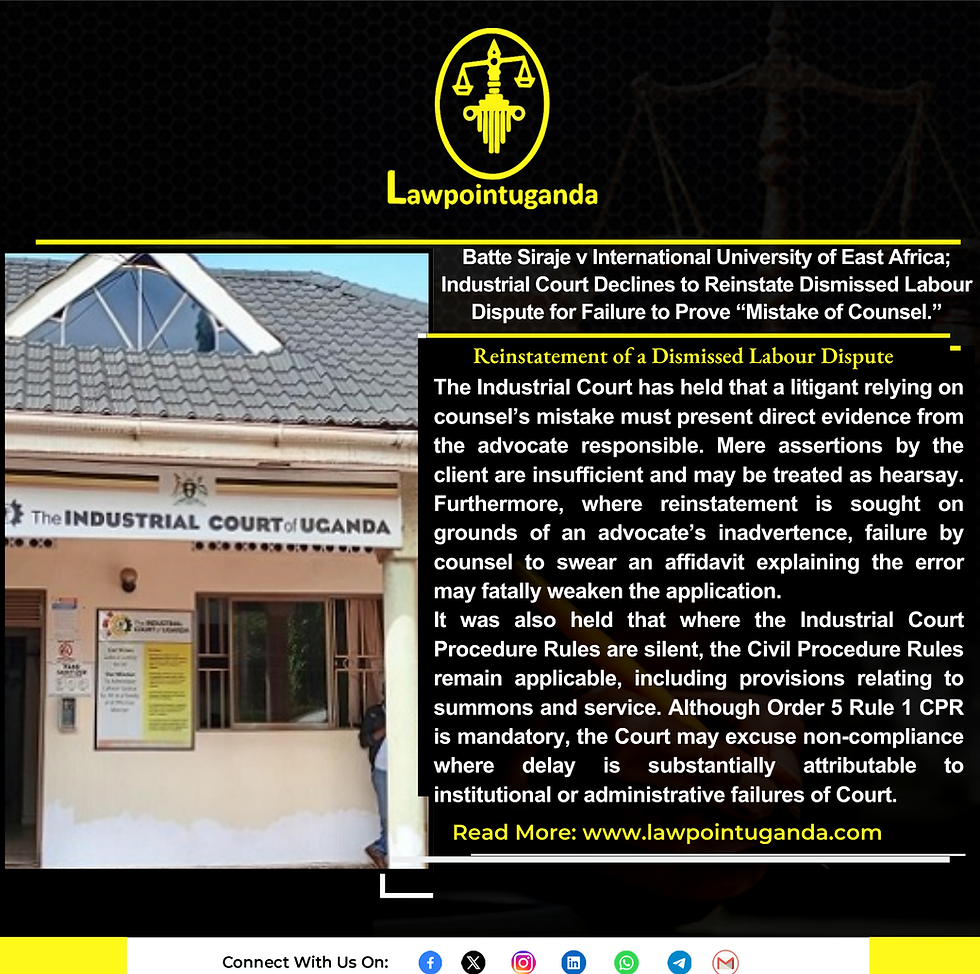
Industrial Court Declines to Reinstate Dismissed Labour Dispute for Failure to Prove “Mistake of Counsel”
Batte Siraje v International University of East Africa
Before: Hon. Justice Anthony Wabwire Musana, Hon. Can Amos Lapenga, Hon. Emmanuel Bigirimana & Hon. Dr. Oling Dawn Kerjew
INTRODUCTION
The Industrial Court dismissed an application seeking to set aside the dismissal of a labour dispute claim after finding that the Applicant had failed to establish “sufficient cause” for non-appearance. Although the Court excused delayed service of the application due to institutional administrative challenges within the Industrial Court, it ultimately held that the Applicant’s allegation of “mistake of counsel” was unsupported by evidence and incapable of sustaining reinstatement of the suit.
FACTS
The Applicant, Batte Siraje, filed an application under Section 98 of the Civil Procedure Act and Orders 9 and 52 of the Civil Procedure Rules seeking to set aside the dismissal of Labour Dispute Claim No. 177 of 2023, which had been dismissed on 17 March 2025 for non-appearance.
The Applicant contended that his advocates, Branmark Advocates, mistakenly diarised the hearing date as 26 March 2025 instead of 17 March 2025, resulting in failure to attend Court. He argued that the mistake was honest and bona fide and that he ought not to suffer prejudice for counsel’s inadvertence.
The Respondent, International University of East Africa, opposed the application through an affidavit sworn by its Director, Hassan Alwi. The Respondent raised a preliminary objection, arguing that the summons had expired before service because: the application had been signed by Court on 29 January 2026; service was only effected on 10 March 2026; and no extension of summons had been sought under Order 5 Rule 1(2) CPR.
The Respondent further argued that the original labour dispute was frivolous and that the dismissal ought not to be disturbed.
ISSUES FOR DETERMINATION
The Court considered two principal issues:
Whether the preliminary objection regarding expired summons had merit; and
Whether the Applicant had shown sufficient cause to warrant setting aside the dismissal of the labour dispute claim.
LEGAL REPRESENTATION
The Applicant was represented by Branmark Advocates through Mr. Alfred Okello.
The Respondent was represented by Kasolo and Khiddu Advocates through Ms. Annet Nassuna.
SUBMISSIONS OF THE PARTIES
Applicant’s Submissions
Counsel for the Applicant submitted that the failure to attend Court arose from an honest and bona fide mistake of counsel in recording the hearing date. The Applicant relied on authorities including Edirisa Kanonyi & Another v Asuman Nsubuga & 3 Others, Gideon Musa Onchwati v Kenya Oil Co. Ltd, Baitamwene v Mukwano Industries (U) Ltd, and Kaggwa v Kasozi Lubega & Others.
The Applicant further submitted that the delay in service of the application was administrative and beyond the litigant’s control. Counsel argued that procedural rules are intended to serve justice rather than defeat it and relied on Article 126(2)(e) of the Constitution and decisions including Nakiganda Anita v Kroon Johanes Maria.
It was submitted that the Court ought not to punish an innocent litigant for errors attributable either to counsel or to institutional delays within the Court system.
Respondent’s Submissions
For the Respondent, counsel submitted that the summons had expired by operation of law under Order 5 Rule 1(2) CPR because service was effected outside the prescribed period without leave of Court.
Relying on James Andate Okanya v New Vision Printing & Publishing Company Ltd and Bitamisi Namuddu v Rwabuganda Godfrey, counsel argued that dismissal was mandatory once summons expired.
The Respondent further submitted that Article 126(2)(e) of the Constitution could not be used as a “magic wand” to cure mandatory procedural defects.
On the merits, the Respondent argued that the allegation of “mistake of counsel” was unsupported and amounted to an abuse of Court process. Counsel relied on Commodity Export International Ltd v Kabarole Hillside Secondary School & 2 Others and urged the Court to dismiss the application with costs.
COURT’S FINDINGS
Preliminary Objection on Expired Summons
The Court acknowledged that the summons had indeed been served outside the timelines stipulated under Order 5 Rule 1(2) CPR and that, technically, the application was liable to dismissal.
However, the Court declined to uphold the objection because the delay largely resulted from institutional shortcomings within the Industrial Court itself.
The Court observed that the application had been filed on 25 March 2025 but was only signed by Court on 29 January 2026, approximately ten months later.
In a significant acknowledgment of systemic challenges, the Court stated;
“The Court is not staffed as it should be under Sections 10 and 14 of the Labour Disputes (Arbitration and Settlement) Act…”
The Court noted that the Industrial Court presently operated with only two Judges and a Registrar despite the statutory staffing structure requiring more judicial officers.
The Court held that litigants should not suffer prejudice due to administrative inefficiencies within the judiciary and stated;
“To penalize a litigant for delays occasioned by the Court’s own staffing constraints would be to elevate form over substance and defeat the ends of justice.”
Accordingly, the preliminary objection was overruled.
2. Whether the Applicant Established “Sufficient Cause”
The Court then considered whether the Applicant had demonstrated sufficient cause for failure to attend Court.
Relying on Kavule Investment Ltd v Tropical Bank Ltd, National Insurance Corporation v Mugenyi & Co. Advocates, and Nakiride v Hotel International Ltd, the Court reaffirmed that an applicant seeking reinstatement must show;
an honest intention to attend Court;
diligence in the matter; and
a reasonable explanation for non-appearance.
The Court also reiterated that “mistake of counsel” may constitute sufficient cause in appropriate cases.
However, the Court found the Applicant’s case fundamentally defective because no affidavit had been filed by counsel to verify the alleged diary mistake.
The Court observed;
“Without the benefit of Mr. Okello’s averments, the Court is unable to interrogate the honest and bonafide mistake of Counsel.”
The Court held that the Applicant’s assertions regarding counsel’s mistake amounted to hearsay because the alleged mistake was not personally verified by counsel.
The Court further noted inconsistencies in the Applicant’s position. Whereas the Applicant claimed to have instructed Branmark Advocates, the Court record contained a notice of self-representation filed by the Applicant himself.
The Court found this inconsistency irreconcilable and held that the Applicant had failed to prove effective legal representation at the material time.
Citing Mupapa Paul & Itiko Moses v Mbulyo Frederick, the Court emphasized that where a litigant relies on mistake of counsel, it must be demonstrated that proper instructions had indeed been given to counsel.
The Court concluded;
“We are not satisfied in the present case that the Applicant has shown that he intended to attend Court and was prevented from attending Court by sufficient cause.”
The application was therefore dismissed.
HOLDING
The Industrial Court held that;
Although the summons had technically expired before service, the delay resulted largely from administrative constraints within the Industrial Court and should not be visited upon the litigant;
The Applicant failed to establish sufficient cause for non-appearance;
allegations of “mistake of counsel” must be supported by affidavit evidence from counsel concerned; and
The application to reinstate the labour dispute was therefore dismissed.
The Court made no order as to costs.
Read the full case
KEY TAKEAWAYS
1. “Mistake of Counsel” Must Be Properly Proved
A litigant relying on counsel’s mistake must present direct evidence from the advocate responsible. Mere assertions by the client are insufficient and may be treated as hearsay.
2. Affidavits of Counsel Are Critical
Where reinstatement is sought on grounds of advocate inadvertence, failure by counsel to swear an affidavit explaining the error may fatally weaken the application.
3. Industrial Court May Apply the Civil Procedure Rules
Where the Industrial Court Procedure Rules are silent, the Civil Procedure Rules remain applicable, including provisions relating to summons and service.
4. Expired Summons Can Still Be Excused in Exceptional Circumstances
Although Order 5 Rule 1 CPR is mandatory, the Court may excuse non-compliance where delay is substantially attributable to institutional or administrative failures of Court.
5. Administrative Delays Should Not Be Visited on Litigants
The ruling strongly recognises the operational realities affecting the Industrial Court and affirms that litigants should not automatically suffer because of judicial staffing constraints.
6. Consistency in Representation Matters
A party who files a notice of self-representation may face difficulty later asserting reliance on counsel unless the record clearly demonstrates continuing instructions to advocates.
7. Reinstatement Applications Require Demonstrable Diligence
The Court reaffirmed that the central test is whether the applicant genuinely intended to attend Court and took reasonable steps to do so.


.jpg)

Comments