
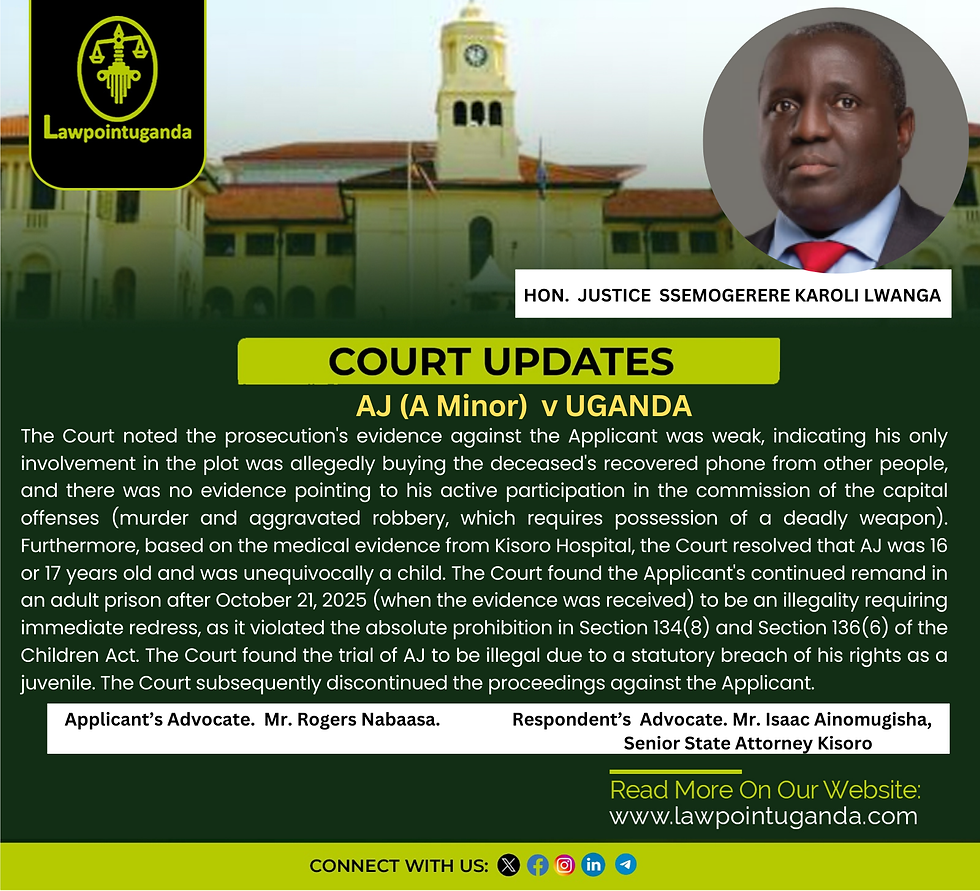
Where a juvenile is held in an adult prison in violation of the Children Act, the Court has the power to discontinue criminal proceedings; High Court at Kabale Reaffirms

📝 Background and Brief Facts
The Applicant, AJ (A Minor), was charged along with six co-accused with Murder (contrary to Sections 171 and 172 of the Penal Code Act, Cap 128) and Aggravated Robbery (contrary to Sections 266(2) and 267 of the Penal Code Act).
At the commencement of the trial on October 20, 2025, Counsel for the Applicant objected to the admission of Form PF-24 (age record) as an agreed document. The Court then ordered a medical examination for two of the accused, A6 (Asasira Junior), who is the Applicant, and A7 (Barack Junior), to ascertain their ages.
The Principal Dental Officer of Kisoro Hospital examined the Applicant and reported that no wisdom teeth were present, concluding that the Applicant was between 16 and 17 years old. This finding confirmed the Applicant was a child/minor under the law. Conversely, A7 was confirmed to be an adult (age 18 to 25).
The Court noted the prosecution's evidence against the Applicant was weak, indicating his only involvement in the plot was allegedly buying the deceased's recovered phone from other people, and there was no evidence pointing to his active participation in the commission of the capital offenses (murder and aggravated robbery, which requires possession of a deadly weapon). The Applicant had spent more than six months in remand in an adult facility prior to the age determination.
📋 Procedural History
The core procedural history stems from the Applicant's successful application to determine his age:
The Applicant was charged with two capital offenses alongside adults.
An order for age determination was granted and confirmed the Applicant was a juvenile.
The Court found that the Applicant had been illegally detained on remand for over six months in an adult facility.
Subsequently, the Court dropped all charges against the Applicant and discontinued the proceedings immediately under Section 17(2)(a) of the Judicature Act, Cap 13.
🔎 Issues for Determination
What was the legal effect of finding AJ to be a minor on his continued detention in Kisoro Prisons?
Whether the continued criminal proceedings against the Applicant were legally permissible.
What remedies were open to the parties?
🗣️ Submissions
Applicant's Submissions
Counsel for the Applicant, Mr. Rogers Nabaasa, confirmed the medical report placing AJ's age between 16 and 17 years.
He argued for two illegalities:
Illegal Remand Duration: Citing Section 136(5)(a) of the Children Act, Cap 59, which states that a minor shall not be on remand exceeding three months for an offense punishable by death. AJ had been on remand since November 11, 2024, exceeding the limit.
Illegal Place of Remand: Citing Section 136(6) of the Children Act, which prohibits remanding a child in an adult prison. AJ had been held in the adult government prisons of Kisoro and Ndorwa.
Counsel prayed that the trial be discontinued under Section 17(2) of the Judicature Act due to these continuing illegalities.
He cited Uganda v Kakube Stone alias Topher, Criminal Session No. 74 of 2022, where proceedings were discontinued against a juvenile offender under the Children Act.
He emphasized that the time limit remained critical even after committal proceedings and that a child's rights must be enforced based on their age at the time of the offense.
Respondent's Submissions
Counsel for the Prosecution, Mr. Isaac Ainomugisha, did not contest the determination of AJ's age by Kisoro Hospital.
He agreed that a juvenile had been on remand for more than three months.
He disagreed with the Applicant's remedy of immediate release, praying instead that the Applicant be released on a court bond under the circumstances.
He sought to distinguish the Kakube case, stating that its decision was based on a period not exceeding twelve months from plea taking.
LEGAL REPRESENTATION
1. Mr. Rogers Nabaasa represented the Applicant.
2. Mr. Isaac Ainomugisha, Senior State Attorney, Kisoro, represented the Respondent.
⚖️ Resolution of Issues
Court addressed itself to two issues. First, resolving on the legality of AJ’s remand in an adult prison, after determination of his age as a minor. A related issue is his continued detention in an adult prison. Second, court must make a decision on the reliefs requested by Counsel for the applicant under Section 17 (2) of the Judicature Act.
The Court first defined a child under Section 2 of the Children Act Cap 62, as a person below the age of eighteen years. Court emphasized that the definition above must be read together with a long title of the Act to understand the purpose of the Act. The long title reads as follows:
‘’An Act to reform and consolidate the law relating to children; to provide for the care, protection and maintenance of children; to provide for local authority support for children; to establish a family and children court; to make provision for children charged with offences and for other connected purposes.’’ The essence of reading the definition of a child and the long title is that while in criminal proceedings, the accused is found to be a child, the provisions of the Children Act automatically apply.
Court opined that determination of age is one of the produral safeguards in the Act. Part XII, of the Act governs children charged with offences. Section 133 (1) of the Act states that 12 is the age of criminal responsibility and also Section 133 (3) of the Act vests power in court to determine the age of a child. It provides as follows:
‘’Subject to subsection (2), the court shall determine the age based ona full assessment of all available information, giving due consideration to official documentation including a birth certificate, school records, health records, statements certifying age from the parent or child, or medical evidence.’’
Section 133 (5) of the Act, allows for presumption of age, in respect of a child pending determination under Section 133 (3) of the Act. it provides as follows:
‘’A person shall be presumed to be a child if he or she claims or appears to be younger than eighteen years old pending a conclusive determination of age by court.’’ These provisions allows courts to safeguard the rights of children in the criminal justice system.
Court observed that this section vests in court the powers to determine the age of a child based on a full assessment of all available information. The forms where age may be considered include; but are not limited to birth certificates, school records, health records, and statements certifying age from the parent or child or medical evidence. Court resolved that the age of AJ, was 16 or 17 years old, and was a child, based on medical evidence, from Kisoro Hospital.
On the legality of his remand, court cited section 134 (8) of the Act which prohibits detention of children with adults of which it is absolute. Section 136 of the Act was relied on by court which limits remanding of children to a remand home under section 136 (1) of the Act; where no such home exists, a place of safe custody under section 136 (2) of the Act. On October 21, 2025,this court on receipt of evidence from Kisoro Hospital made a finding under the Act, that AJ was a child, requiring immediate redress from the court to terminate such remand in an adult prison.
While on reliefs requested by counsel for the applicant under section 17 (2) (a) of the Judicature Act, court found the trial of AJ illegal and discontinued proceedings against the applicant
Court’s Findings
Hon. Justice Ssemogerere, Karoli Lwanga after reading the summary of the case; and after hearing the prosecution witnesses found the trial of AJ illegal and discontinued proceedings against him.
While citing Section 133 (5) of the Act, which allows for presumption of age, in respect of a child pending determination under Section 133 (3) of the Act, Court observed that this section vests in court the powers to determine the age of a child based on a full assessment of all available information.
The forms where age may be considered include; but are not limited to birth certificates, school records, health records, and statements certifying age from the parent or child or medical evidence. Court resolved that the age of AJ, was 16 or 17 years old, and was a child, based on medical evidence, from Kisoro Hospital.
Summary of the court’s determination.
1. The Court dropped all charges against the applicant, a child and discontinued the proceedings since he was remanded in an adult prison.
2. The applicant was found to be between the age of 16 or 17 years old which makes him a child based on medical evidence, from Kisoro Hospital.
Rule of law or legal principle applied.
While citing Section 136 (6) of the Children Act Cap 62, which states that a child shall not be remanded in an adult prison, court declared the trial of the applicant illegal and discontinued all criminal proceedings against him. This was because the applicant AJ, A6 on the indictment was remanded in prison on November 11, 2024 and he had been held in the two Ugandan government prisons of Kisoro and Ndorwa, in Kisoro and Kabale districts respectively.
To buttress the position there above, court cited the case of Uganda v Kakube Stone alias Topher, Criminal Session No. 74 of 2022 where Batema J., on June 29, 2023, discontinued proceedings against the juvenile offender under Section 136 of the Children Act.
✨ Key Takeaways
Mandatory Discontinuation
Where a juvenile is held in an adult prison in violation of the Children Act, the Court has the power to discontinue criminal proceedings against the child.
Remand Limit for Juveniles (Capital Offenses)
A child must not be remanded for an offense punishable by death for a period exceeding three months (Section 136(5)(a)).
Criminal Responsibility
The age of criminal responsibility in Uganda begins at 12 years (Section 133(1) of the Children Act).
Methods of Age Determination
A child's age is determined by the Court using a full assessment of all available information, which includes: medical evidence, birth certificates, school records, health records, and parent/child statements.
Aggravated Robbery
The offense of Aggravated Robbery, contrary to Section 266(2) of the Penal Code Act, requires the use of or possession of a deadly weapon and is punishable by death.
Brief by Ssali Junior John Nsigejjerawa (Son of Rule of Law)
Read the full case


.jpg)

Comments