
Constitutional Court of Uganda Dismisses Petition by Civilian Challenging Court Martial Conviction

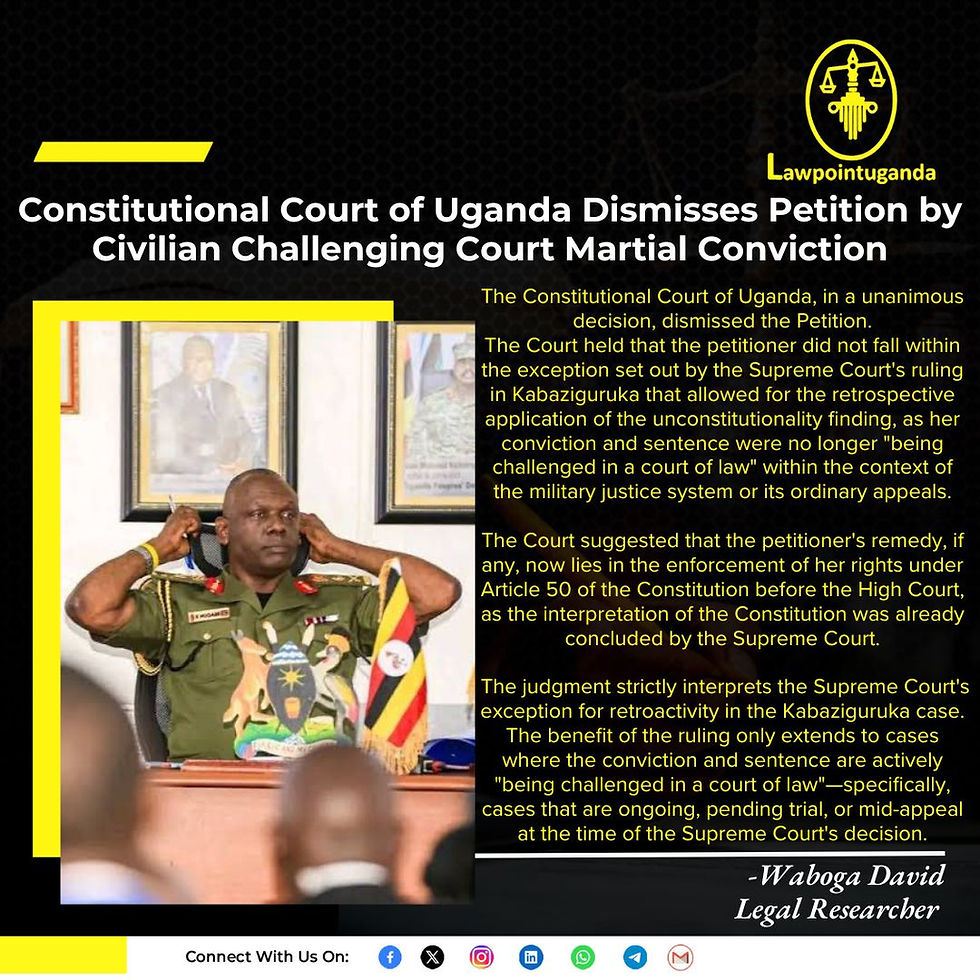
Court: Constitutional Court of Uganda
(Coram: Mulyagonja, Kitariisibwa Katunguka, Musisi, Byaruhanga Rugyema & Nambayo, JJCC)
Case Kyomuhangi Elizabeth v. Attorney General
Overview
The Constitutional Court of Uganda has dismissed a petition filed by a civilian who was tried, convicted, and sentenced by the Court Martial for murder, seeking to benefit from a recent Supreme Court decision that declared the trial of civilians by Court Martial unconstitutional. The Court ruled that the petitioner's case did not fall under the exception allowing for retrospective application of the Supreme Court's decision, as her appeal process had been concluded before the said decision was issued.
🏛️ Facts
The petitioner, Kyomuhangi Elizabeth, a civilian, was arrested in October 2010 together with two UPDF soldiers and charged with murder.
She was tried before the 2nd Division Court Martial at Makenke Barracks, convicted, and sentenced to 40 years’ imprisonment, later reduced to 30 years by the Court Martial Appeal Court.
She challenged her conviction and sentence before the Constitutional Court, arguing:
The Court Martial lacked jurisdiction to try a civilian.
Section 179 of the UPDF Act, which made all criminal offences service offences, was unconstitutional.
The process violated her constitutional rights to a fair hearing, an independent and impartial court, and due process.
The petition was filed after the Supreme Court decision in Attorney General v. Kabaziguruka (2021) which held that military courts lack jurisdiction to try civilians for non-military offences.
⚖️ Issues
The Constitutional Court reframed the sole issue for determination based on prior rulings by the Supreme Court:
Whether this court has the jurisdiction to apply the final orders of the Supreme Court in Constitutional Appeal No. 02 of 2021, Attorney General v. Hon Michael Kabaziguruka, and grant the petitioner the remedies she sought in this petition.
Specifically, whether the petitioner's case falls within the ambit of matters where "the conviction and sentence is being challenged in a court of law" as set out in the Supreme Court's exception to non-retroactivity.
💬 Submissions
Petitioner's Submissions (Kyomuhangi Elizabeth)
Conceded that the questions concerning the unconstitutionality of trying civilians in Court Martials were resolved by the Supreme Court in Attorney General v. Hon Michael Kabaziguruka.
Emphasized that the Supreme Court's decision provided guidance that while the judgment would not apply retrospectively, it would apply to those who still had a legal challenge in court about their convictions and sentences.
Asserted that she falls into this category as she had a pending constitutional challenge, and having already served about 15 years of an allegedly illegal sentence, she should be granted the remedies sought, including unconditional release.
Respondent's Submissions (Attorney General)
Contended that the issues in the petition were already adjudicated upon in the Namugerwa Hadijah case (Civil Appeal No. 04 of 2021).
Argued that the GCM is a court of competent jurisdiction established by law and that the petitioner was subject to military law because she was jointly charged with soldiers for a service offence.
Finally, in light of the Supreme Court's decision in Kabaziguruka, they expected the petitioner to withdraw the petition.
👨⚖️ Legal Representation
For the Petitioner, Messrs Jude Byamukama, Rogers Paul Katunguka, and Ms Zahara Tumwejize.
For the Respondent, Mr. Geoffrey Madete (Principal State Attorney) and Mr. Matthew Muhesi (State Attorney).
🏛️ Court's Findings
The Court acknowledged that the Supreme Court in Kabaziguruka's case had made several key declarations, including:
The provisions of the UPDF Act providing for the trial procedure of the GCM and other Courts Martial lack sufficient constitutional guarantees for independence and impartiality.
Sections 2, 179, and 119(1)(g) and (h) of the UPDF Act are unconstitutional as they confer blanket jurisdiction on Courts Martial to try civilians and try persons subject to military law for civil and non-disciplinary offences.
The Constitutional Court then focused on the Supreme Court's order on retroactivity:
"This judgment shall have no retrospective effect on any conviction and sentence imposed, prior to the date of this judgement, save where the conviction and sentence is being challenged in a court of law."
The Court made the following critical findings regarding the petitioner:
Conclusion of Challenge
The petitioner concluded the process of challenging her conviction and sentence on March 27, 2019, when the Court Martial Appeal Court upheld her conviction and reduced her sentence.
No Ongoing Challenge
Her trial before the Court Martial is neither ongoing nor pending in any court.
Constitutional Petition Nature
The Constitutional Petition, filed in 2022, was a challenge to the constitutionality of the law and courts, but the Court Martial process itself had been exhausted.
Aiding and Abetting
The Court Martial had specifically found that the petitioner played a principal role in the planning and execution of the murder and had aided and abetted the commission of the offence (making her a principal offender under the then Penal Code Act).
Lack of Jurisdiction for Redress
The Constitutional Court's jurisdiction under Article 137 is primarily for interpretation, not enforcement of rights where an interpretation has already been conclusively made by the Supreme Court.
(Irene Mulyagonja, JCC): "I would therefore still find that this petition does not fall under the category of cases where the convict is challenging her conviction and sentence. The petitioner concluded the process of challenging her conviction and sentence on 27th March 2019, when the decision was made against her by the Court Martial Appeal Court, albeit reducing her sentence from 40 to 30 years' imprisonment."
✋ Holding
The Constitutional Court of Uganda, in a unanimous decision, dismissed Constitutional Petition No. 03 of 2022.
The Court held that the petitioner did not fall within the exception set out by the Supreme Court's ruling in Kabaziguruka that allowed for the retrospective application of the unconstitutionality finding, as her conviction and sentence were no longer "being challenged in a court of law" within the context of the military justice system or its ordinary appeals.
The Court suggested that the petitioner's remedy, if any, now lies in the enforcement of her rights under Article 50 of the Constitution before the High Court, as the interpretation of the Constitution was already concluded by the Supreme Court.
🔑 Key Takeaways
Retroactivity Exception Clarified
The judgment strictly interprets the Supreme Court's exception for retroactivity in the Kabaziguruka case. The benefit of the ruling only extends to cases where the conviction and sentence are actively "being challenged in a court of law"—specifically, cases that are ongoing, pending trial, or mid-appeal at the time of the Supreme Court's decision.
Exhausted Appeals
Once a civilian has exhausted all military appeals (up to the Court Martial Appeal Court), a subsequent Constitutional Petition challenging the court's jurisdiction will likely not qualify as a case "being challenged" for the purpose of the Kabaziguruka exception.
Article 50 vs. Article 137
The Constitutional Court reiterated its primary role under Article 137 is constitutional interpretation. Where the interpretation has already been settled by the Supreme Court, the avenue for claiming consequential remedies (like release or damages) shifts to the High Court for the enforcement of rights under Article 50 of the Constitution.
Aiding and Abetting
The Court noted that even if the law allowing civilian trials was still valid, the petitioner's conviction for murder (a non-disciplinary offence) stemmed from a finding that she aided and abetted the commission of the offence by soldiers, which the GCM used to justify its jurisdiction.
Read more




.jpg)

Comments