
Tenancy or lease agreement over estate land signed without the co-beneficiaries' consent declared illegal and null, and void; the first defendant found liable for trespass.

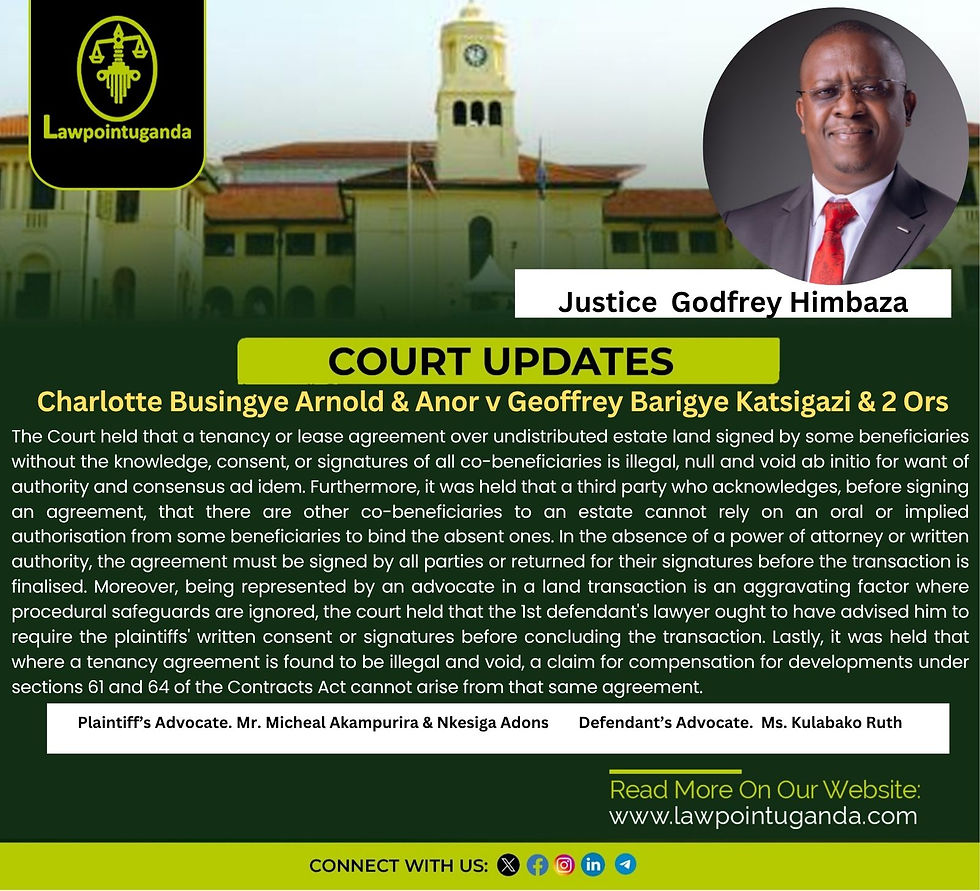
A tenancy or lease agreement over undistributed estate land signed by some beneficiaries without the knowledge, consent or signatures of all co-beneficiaries is illegal, null and void ab initio for want of authority and consensus ad idem. High Court Rules.
Facts
The plaintiffs, Charlotte Busingye Arnold and Yonnioe Kasigi Busingye, being biological sisters of the 2nd defendant (Mark Njirane Busingye) and the 3rd defendant (Sandra Busingye). All four are beneficiaries of the estate of their late father, Charles Busingye, who passed on in 1990. The estate comprises land described as Buruli Block 67, Plot 4 at Nakitoma, Nakasongola District, measuring approximately 259 hectares.
The suit land remained registered in the names of the late Betty Kamugisha Busingye, the deceased administratrix and biological mother of all parties, who passed on in 1997/1998. The plaintiffs, who reside and work in the United Kingdom, had, since 2002, been charged with the general welfare of the 2nd and 3rd defendants, who remained in Uganda.
On 3rd September 2020, the 2nd and 3rd defendants entered into a tenancy agreement with the 1st defendant, Geoffrey Barigye Katsigazi, a member of the Uganda Armed Forces, to rent the suit land for three years at a yearly rent of Uganda Shillings Nine Million, totalling Uganda Shillings Eighteen Million. The agreement named all four siblings, including the plaintiffs, as parties, but only the 2nd and 3rd defendants appended their signatures.
The 1st defendant took possession of the land and proceeded to construct a water reservoir, erect fencing poles, and drive out existing tenants.
The plaintiffs learned of the transaction in March 2021 through a cousin. Upon discovery, they convened a meeting at the offices of their advocates, at which the 2nd and 3rd defendants produced a copy of the tenancy agreement. The plaintiffs condemned the transaction, noting that they had never been consulted, had not consented, and had not signed the agreement.
All efforts to stop the 1st defendant from remaining in possession, including reporting to the Uganda Police, proved futile. The plaintiffs subsequently filed the suit, seeking various declarations, orders of eviction, injunctions, and damages.
Issues for determination
Issue 1:
Whether the tenancy agreement entered into between the 1st, 2nd, and 3rd defendants was illegal, null, and void.
Issue 2:
Whether the 1st defendant was a trespasser on the suit land.
Issue 3:
What remedies were available to the parties.
Legal representation
The plaintiffs were represented by Mr. Michael Akampurira of M/S Akampurira & Partners, together with Mr. Nkesiga Adons of M/S Muhumuza, Kateeba & Co. Advocates.
Ms. Kulabako Ruth of M/S Kulabako, Birungi, Makubuya & Co. Advocates represented the 1st defendant.
The 2nd and 3rd defendants did not file Written Statements of Defence despite service, and the court directed that the suit proceed ex parte against them.
Submissions of the parties
On Issue 1 Validity of the tenancy agreement
Plaintiffs
Counsel for the plaintiffs submitted, on the first limb of want of capacity and authority, that at the time the tenancy agreement was purportedly entered into, the suit land remained registered in the names of the deceased administratrix, Betty Kamugisha Busingye, and that there was no subsisting administrator of the estate in 2020.
He submitted that the 2nd and 3rd defendants held no letters of administration and were mere beneficiaries and that, without powers of administration, they lacked any authority to alienate, lease, rent out, or encumber estate property.
On the second limb of lack of consent, counsel submitted that the plaintiffs were never consulted, notified, or involved in the execution of the tenancy agreement; that they only learned of it in March 2021; and that they had never given the 2nd and 3rd defendants permission to rent out the premises, had never ratified the agreement, and had, in fact, objected to it upon discovery.
Counsel further submitted that there was, therefore, no consensus ad idem. He submitted that the 1st defendant failed to adduce any power of attorney, written authority, or other documentary evidence authorising the 2nd and 3rd defendants to contract on behalf of the plaintiffs and that the tenancy agreement dated 3rd September 2020 was void ab initio for want of capacity, authority, and consent.
1st Defendant
Counsel for the 1st defendant submitted that, at the time the tenancy agreement was entered into, the 2nd and 3rd defendants were beneficiaries with equal rights at law with the plaintiffs over all the estate of the late Charles Busingye.
He further submitted that PW1 had admitted in her witness statement that the suit land was previously rented out while the plaintiffs were abroad and that such transactions were handled by the 2nd and 3rd defendants together with the caretaker and that this transaction was no different from those previous ones.
Counsel argued that the 2nd and 3rd defendants did not require powers of attorney to derive sustenance from the estate because all beneficiaries had equitable rights since no distribution had taken place. He relied on Dr. Diana Kanzira v Herbert Natukunda Rwanchwende, Civil Appeal No. 81 of 2020, and submitted that the tenancy agreement of 3rd September 2020 was valid.
Plaintiffs (Rejoinder)
In rejoinder, counsel for the plaintiffs submitted that the absence of a subsisting administrator did not mean that any beneficiary had authority to lease or alienate estate property to the detriment of other beneficiaries.
He further submitted that the assertion that tenancy transactions were ordinarily handled by the caretaker and the 2nd and 3rd defendants was unsupported by any evidence, was not pleaded by the 1st defendant, and constituted a new argument raised only at the submissions stage.
He relied on Mubangizi Haruna v Gumisa & 19 Ors, reaffirming that parties are bound by their pleadings and that any evidence or argument inconsistent with, or not founded on, the pleadings amounts to a fatal departure.
Counsel further distinguished Dr. Diana Kanzira on three grounds: that, in that case, each beneficiary had defined usage rights over individual portions and it was the beneficiary’s own specific portion that was alienated; that the challenge to capacity in that case arose from mental unsoundness and not want of authority; and that, in that case, the administrator had participated in and consented to the transaction by conduct, grounding promissory estoppel, circumstances entirely absent in the present case.
Court’s findings
On burden and standard of proof
The learned Judge found that it was not in contention that the tenancy agreement was not signed by the plaintiffs, that all four siblings were beneficiaries of the same estate, and that the suit land remained registered in the names of the deceased administratrix. The court found that the tenancy agreement named all four siblings as contracting parties but only the 2nd and 3rd defendants had signed it.
"It is not clear how the 1st defendant satisfied himself of the above without a duly endorsed and registered Power of Attorney from the plaintiffs appointing the 2nd and 3rd defendants to act on their behalf, nor was there any written authority authorising the 2nd and 3rd plaintiffs to act on the plaintiff's behalf. Since the defendant had already interacted with the plaintiffs before signing the agreement, in the absence of powers of attorney or a written authority, the agreement should have been sent to them for signature and then returned for finalization of the transaction."
The learned Judge found that it was a calculated scheme between the 1st defendant and the 2nd and 3rd defendants to exclude the plaintiffs from the transaction, and that this conclusion was reinforced by the failure of the 2nd and 3rd defendants to file a Written Statement of Defence.
The court clarified the law on estate transactions, reaffirming that transactions on estate property, including leasing, renting out or selling, require the consent of all beneficiaries, and that a beneficiary cannot validly dispose of or lease out the whole or another beneficiary's share without proper authorisation, citing Biribonwa Patrick & ors v Nyombi Herbert, Civil Appeal No. 0067 of 2022.
The court further reaffirmed the exception that a beneficiary may deal with only their specific beneficial interest without other beneficiaries' consent, but only where the family has formally apportioned and allocated specific portions, the position in Dr. Diana Kanzira, circumstances entirely different from the present case where the 2nd and 3rd defendants purported to deal with the entire suit land.
The court found that the 1st defendant, having been represented by an advocate and having personally acknowledged that all four siblings were beneficiaries with equal rights, ought to have required the plaintiffs' consent in writing, either by letter of consent or by appending their signatures on the agreement, before concluding the transaction.
The learned Judge accordingly resolved issue one in the affirmative, finding that the tenancy agreement was illegal, null and void for lack of the plaintiffs' consent and authority.
On issue 2 regarding Trespass
The learned Judge applied the definition of trespass to land set out by the Supreme Court in Justine E.M.N. Lutaaya v Stirling Civil Engineering Company Ltd, Civil Appeal No. 11 of 2002, which provides that trespass to land occurs when a person makes an unauthorised entry upon land and thereby interferes with another person's lawful possession, and that legal possession is vested in the holder of a certificate of title.
The court found that, having already determined in issue one that the tenancy agreement was entered into without authority, the 1st defendant's entry onto the suit land on 3rd September 2020 was unauthorised.
The learned Judge found that the plaintiffs had discharged their burden of proof on the balance of probabilities and accordingly resolved issue two in the affirmative, finding the 1st defendant liable for trespass.
On the 1st defendant's claim for compensation for developments
The court declined to pronounce itself on the 1st defendant's claims for compensation under sections 61 and 64 of the Contracts Act for two reasons. First, the learned Judge found that having already declared the tenancy agreement illegal and void ab initio, it would amount to approbation and reprobation, blowing hot and cold, to then order compensation on the basis of that same illegal agreement. The court further noted that clause 10(c) and (d) of the agreement itself expressly provided that any permanent developments or fixtures would remain the property of the landlord and that the tenant would not seek compensation for them. Second, the court found that no counterclaim had been raised by the 1st defendant in his Written Statement of Defence as required by Order 8 rules 7 and 8 of the Civil Procedure Rules, and that the court was accordingly unable to pronounce itself on claims that were neither brought by way of counterclaim nor pleaded in the defence.
On damages
The court reaffirmed that trespass is actionable per se whether or not the plaintiff has sustained actual damage, and that a plaintiff who proves trespass is entitled to compensation for damage and loss suffered, which may include general, special or exemplary damages, citing James Fredrick Nsubuga v AG HCCS No. 13/1993.
The learned Judge found that while there was no evidence of physical damage, PW1's unchallenged testimony established that the ordinary rental value of the suit land was Uganda Shillings 30,000,000 per annum, whereas the 1st defendant had rented it for only Uganda Shillings 18,000,000.
The court found that the plaintiffs suffered inconvenience because the 1st defendant remained in possession for over three years after the expiry of the tenancy, and that they were accordingly entitled to damages.
Holding
A declaration was issued that the tenancy agreement signed between the defendants in respect of Buruli Block 67, Plot 4, Nakitoma, Nakasongola District is illegal, null and void.
A declaration was issued that the 1st defendant is a trespasser on the suit land.
The 1st defendant was ordered to give vacant possession of the suit land to the plaintiffs with immediate effect, failing which he shall be lawfully evicted.
A permanent injunction was issued restraining the 1st defendant, his servants, agents and persons deriving authority from him from accessing, occupying or interfering with the suit land.
A permanent injunction was issued restraining the 2nd and 3rd defendants and persons deriving authority from them from dealing or interfering with the suit land until distribution of the estate of the late Charles Busingye.
The 1st defendant was ordered to pay the plaintiffs general damages of Uganda Shillings 25,000,000 (Twenty-Five Million Shillings only).
The 2nd and 3rd defendants were each ordered to pay Uganda Shillings 5,000,000 (Five Million Shillings only) as general damages, recoverable from their respective shares in the estate at the point of distribution.
Interest on the above awards at commercial rate per annum from the date of judgment until payment in full.
Costs of the suit were awarded to the plaintiffs.
Read the full decision
Key takeaways
A tenancy or lease agreement over undistributed estate land signed by some beneficiaries without the knowledge, consent or signatures of all co-beneficiaries is illegal, null and void ab initio for want of authority and consensus ad idem. The right to deal with estate land without co-beneficiaries' consent is limited to a beneficiary's own specific allocated portion and only where the estate has been formally apportioned.
A third party who acknowledges, prior to signing an agreement, that there are other co-beneficiaries to an estate cannot rely on an oral or implied authorisation from some beneficiaries to bind the absent ones. In the absence of a power of attorney or written authority, the agreement must be signed by all parties or returned for their signatures before the transaction is finalised.
Being represented by an advocate is an aggravating factor where procedural safeguards are ignored: the court held that the 1st defendant's lawyer ought to have advised him to require the plaintiffs' written consent or signatures before concluding the transaction.
A counterclaim for compensation in respect of developments made on land must be formally pleaded in the Written Statement of Defence in accordance with Order 8 rules 7 and 8 of the Civil Procedure Rules. A claim raised only in submissions without a pleaded counterclaim cannot be entertained by the court.
Where a tenancy agreement is found to be illegal and void, a claim for compensation for developments under sections 61 and 64 of the Contracts Act cannot arise from that same agreement. Seeking compensation while the agreement has been declared illegal amounts to approbation and reprobation.
Trespass is actionable per se. A beneficiary of an estate has locus standi to sue in their own name to protect estate property without first obtaining letters of administration, following Israel Kabwa v Martin Adala Banoba Mugisha SCCA No. 52/1995.


.jpg)

Comments