
Oral evidence from credible clan elders can establish land ownership under customary succession, especially in the absence of a Certificate of Title. High Court at Mbale Overturns Lower Court Decision

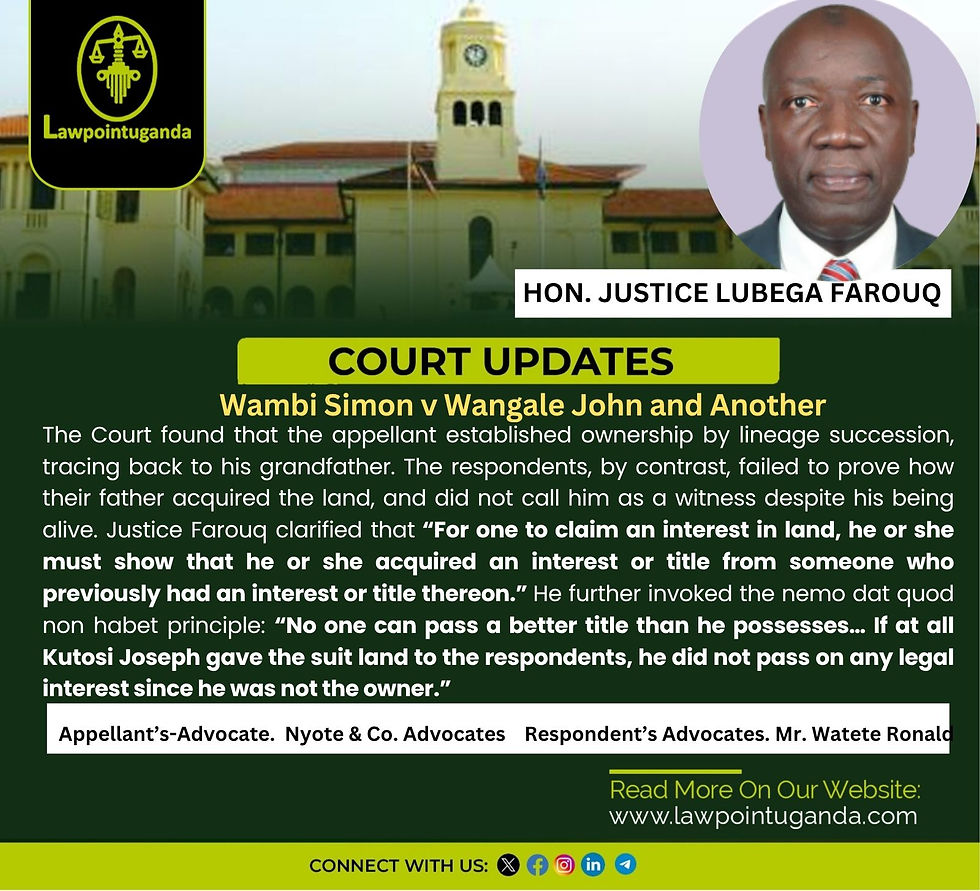
Facts
The appellant, Wambi Simon, sued the respondents, Wangale John and Lukoye George, in Bududa Chief Magistrate’s Court, Civil Suit No. 10 of 2023, seeking a declaration of ownership over land located in Shirukhu village, Bumwalye Parish, Bulucheke Sub-County, Bududa District.
The land was originally owned by his grandfather, the late Buwende Yokoyata, who bequeathed it to his son Joel Wabuti (the appellant’s father) before his death in 1979. The land was later placed under the care of the respondents’ father, Joseph Kutosi, while the appellant resided in Kenya.
Upon returning, the appellant resumed possession and planted eucalyptus trees. In 2023, however, the respondents allegedly trespassed, cultivated crops on the land, and destroyed the appellant’s trees.
The respondents contended that their father, Kutosi, lawfully acquired the land in 1988 from one Wamalia Kuloba and subsequently distributed it to them in 2013 as their share.
The trial court dismissed the suit, finding that the appellant failed to prove ownership. Aggrieved, he appealed to the High Court at Mbale.
Issues on Appeal
Whether the appellant proved ownership of the suit land.
Whether the respondents were trespassers on the suit land.
Whether the trial magistrate properly evaluated the evidence.
Whether the trial magistrate’s decision occasioned a miscarriage of justice.
Appellate Issues (Grounds of Appeal)
The Appellant advanced four grounds:
(a) The trial magistrate erred in law and fact by holding that the Appellant failed to prove ownership of the suit land.
(b) The trial magistrate erred in law and fact by holding that the Respondents were in possession and not trespassers.
(c) The trial magistrate did not properly evaluate the evidence on record, leading to a wrong decision.
(d) The trial magistrate's decision occasioned a miscarriage of justice to the Appellant.
The Appellant sought to set aside the lower court's judgment, declare him the owner, and award costs for both courts.
Submissions
The appeal proceeded on written submissions following a joint application by counsel on October 5, 2025, which the High Court granted. Both parties filed submissions within court timelines, which the Court duly considered.
The Appellant's submissions emphasized the unchallenged evidence of lineage succession from Buwende Yokoyata to Wabuti Joel, and thence to the Appellant, corroborated by clan leaders and eyewitnesses. They highlighted the Respondents' failure to prove their father's acquisition of title and argued the application of the nemo dat quod non habet rule (no one can transfer better title than they possess).
The Appellant also addressed a preliminary objection on service of the memorandum of appeal, producing an affidavit confirming service on March 12, 2025 (within 21 days of sealing on February 27, 2025), in compliance with Order 5 Rule 1(2) of the Civil Procedure Rules.
The Respondents' submissions raised a preliminary objection, alleging non-service of the memorandum of appeal, citing Order 49 Rule 2 and Scovia Chebuson v. Monge Francis (HCCA No. 85 of 2022) [2023]. On the merits, they reiterated their claim of purchase by their father in 1988 and inheritance in 2013, denied any caretaking role for their father, and asserted that the Appellant's claims disclosed no cause of action.
The High Court overruled the preliminary objection, noting that the affidavit of service evidenced timely compliance.
Legal Representation
For the Appellant, Nyote & Co. Advocates
For the Respondents, Counsel Watete Ronald
Court's Findings
As the first appellate court, the High Court re-evaluated the entire record afresh, mindful of its duty to scrutinize evidence without the benefit of witness demeanor (Fr. M. Begumisa & Ors v. E. Tibegana, SCCA No. 17 of 2003). It analyzed each ground seriatim.
Ground 1: Failure to Prove Ownership
The Court found that the trial magistrate erred, as the Appellant's evidence, four witnesses (PW1–PW4), established unbroken customary succession: Buwende Yokoyata's residence and burial on the land (corroborated by PW3, an 85-year-old retired Reverend who knew the family since 1952); inheritance by Wabuti Joel via a clan meeting; and devolution to the Appellant after 1979.
PW2 (clan vice-chairperson, aged 82) and PW4 (clan secretary) confirmed the land's cultural designation and the Respondents' father's mere caretaking role, with clan meetings in 2023 restraining the Respondents’ cultivation.
Contradictions in the Appellant's witnesses (e.g., PW3 on neighbors; PW2/PW3 on Wabuti Joel's location in 1974) were minor and immaterial to ownership lineage. Conversely, the Respondents' evidence (DW1–DW4) failed to prove their father's 1988 purchase, there were no documents or testimony from Joseph Kutosi (alive but uncalled, drawing an adverse inference). DW3 and DW4 admitted ignorance of the acquisition, and clan witnesses rebutted the 2013 allocation claim.
The Court applied Sections 101–103 of the Evidence Act (Cap. 8), placing the burden on the party asserting title (Yakobo M.N. Senkungu & Ors v. Cresensio Mukasa, CACA No. 17 of 2014).
“From the evidence analyzed above, it is clear that the Appellant gets ownership of the suit land from his grandfather Yoko Yata Buwende and later from his father, the late Joel Wabuti. The Respondents, on the other hand, although claiming that they acquired the suit land from their father, Kutosi Joseph, failed to lead evidence to prove how Kutosi Joseph acquired the suit land... Thus, they failed to meet the requirements in Section 103 of the Evidence Act.” (Para. 48)
The Court invoked Ojwang v. Wilson Bagonza (CACA No. 25 of 2002):
“For one to claim an interest in land, he or she must show that he or she acquired an interest or title from someone who previously had an interest or title thereon.” (Para. 49)
Kutosi's long possession without proof of title conferred no ownership, applying nemo dat quod non habet. The land's cultural use and graves underscored family vesting.
Ground upheld.
Ground 2: Respondents Not Trespassers
The Court held that the Respondents trespassed, as their 2020 entry and refusal to desist (despite clan resolutions) interfered with the Appellant's possession (Justine E.M.N. Lutaaya v. Sterling Civil Engineering Co., SCCA No. 11 of 2002).
“Therefore, having found that Kutosi Joseph did not have interest in the suit land, and the Respondents having refused to leave the same upon the advice of the clan leaders, it is evident that the Respondents trespassed on the land.” (Para. 58)
Ground upheld.
Ground 3: Improper Evaluation of Evidence
This ground was struck out as too general, violating Order 43 Rule 2 of the Civil Procedure Rules and precedents such as Arim Felix Clive v. Stanbic Bank (U) Ltd (CACA No. 101 of 2013) and National Insurance Corporation v. Pelican Air Services (CA No. 15 of 2003), which require grounds to specify erroneous ratios decidendi.
“In this case, the third ground... is similar to the ground which was struck out... for being too general. I am bound by that holding.” (Para. 69)
Ground struck out.
Ground 4: Miscarriage of Justice
The Court upheld this ground, holding that the lower court's errors on facts and law rendered a more favorable outcome probable (Olanya v. Ociti & 3 Ors, CA No. 64 of 2017; Halsbury’s Laws of England, 3rd Ed., Vol. 10).
“Therefore, in light of my analysis in Grounds No. 1 and 2, it is apparent that the decision and the judgment of the trial magistrate occasioned a miscarriage of justice to the Appellant.” (Para. 63)
Ground upheld.
Holding
The High Court allowed the appeal and made the following orders:
The judgment and decree of the Chief Magistrate’s Court at Bududa are set aside.
It is declared that the appellant, Wambi Simon, is the lawful owner of the suit land.
The respondents are trespassers.
Costs of the appeal and of the lower court are awarded to the appellant.
“The suit land belonged to the late Yoko Yata Buwende who passed it on to the appellant’s father, and upon his death, by way of lineage succession, the same passed to the appellant.”
Key Takeaways
⚖️ Lineage and Customary Ownership
Oral evidence from credible clan elders can establish land ownership under customary succession, especially in absence of written title.
📜 Burden of Proof
Parties asserting ownership must prove acquisition through a person with legitimate title, mere possession is insufficient (Evidence Act, ss. 101–103).
🚫 Nemo Dat Rule Applied
A caretaker cannot confer ownership of land to others.
🏠 Trespass Definition Affirmed
Unauthorized occupation, even by relatives, amounts to trespass where ownership is proven (Lutaaya v Sterling principle reaffirmed).
⚖️ Appellate Duty
The first appellate court must re-evaluate evidence afresh and correct misdirections by lower courts (Begumisa v Tibegana).
⚠️ Grounds of Appeal
Must be precise and challenge specific findings; general grounds risk being struck out (Arim Felix Clive v Stanbic Bank).
🧾 Procedural Compliance
Timely service of the memorandum of appeal within 21 days satisfies Order 5 rule 1(2) Civil Procedure Rules.
Read the full case below



.jpg)

Comments