
Major Win for Data Protection and Privacy as Kabale High Court Convicts Accused in Rape Case Involving Minor

Introduction
Rarely do Ugandan courts anonymise victims’ identities in sensitive proceedings such as rape, defilement, adoption, or divorce. This persistent practice creates a double jeopardy, victims are re-exposed to public scrutiny even as they seek justice.
Balancing access to justice with the right to privacy has therefore remained a complex judicial challenge in Uganda’s criminal justice system.
The right to privacy is constitutionally guaranteed under Article 27 of the Constitution of the Republic of Uganda, 1995, which protects every person against unlawful interference with their private affairs. This right is further reinforced by the Data Protection and Privacy Act, which mandates all entities including judicial institutions to collect, process, and disclose personal data only where necessary, lawful, and with adequate safeguards.
Internationally, Uganda’s obligations under instruments such as the African Charter on Human and Peoples’ Rights (Article 9 and 18), the Universal Declaration of Human Rights (Article 12), and the Convention on the Rights of the Child (Article 16) equally recognise the right to privacy and dignity, particularly for minors and victims of sexual violence.
In this context, the High Court at Kabale, presided over by Hon. Justice Karoli Lwanga Ssemogerere, has set an encouraging precedent by anonymising the victim throughout the proceedings and the judgment in Uganda v. Agunda Kenneth, HCT-11-CR-CO-0101 of 2021. The Court referred to the victim only by her initials (“AA”), thereby aligning judicial practice with both data protection principles and victim-sensitive justice.
This decision marks a significant step forward in embedding data protection and privacy within Uganda’s judicial processes, ensuring that the pursuit of justice does not come at the cost of personal dignity and protection of victims’ data.
FACTS
The accused, Agunda Kenneth (aged 25), was charged with rape contrary to Sections 123 and 124 of the Penal Code Act, Cap 128. The offense allegedly occurred on April 4, 2021 (Easter Sunday), in Muhanga Town Council, Rukiga District. The victim, "AA" (a pseudonym, aged 14 at the time), was visiting her aunt, PW2 (Akankunda Pleasant, aged 25), to celebrate the holiday.
The accused, a neighbor of PW2, was present at PW2's home, where he interacted with AA and PW2 for approximately one hour, including consumption of alcohol.In the evening, AA sought PW2's guidance to use a nearby toilet (latrine), located at a distance from the residence. Upon exiting the toilet, AA encountered the accused outside. He pushed her back inside, expressed intent to "play sex" with her, overpowered her due to his physical strength, grabbed her neck, covered her mouth, raised her dress, pulled down her underwear, and had unlawful carnal knowledge of her without consent.
The assault left AA with physical injuries, including vaginal lacerations and the absence of a hymen, indicative of penetration. The accused threatened to kill her if she disclosed the incident.AA returned to PW2's house but remained silent due to fear. Later that evening, upon returning home, AA confided in her mother, PW3 (Kyarimpa Phiona, aged 39).
PW3 observed bloodstains on AA's body and clothing, confirming genital injuries. PW3 and AA reported the matter to Muhanga Police Station, where AA identified the accused during an apprehension operation involving police and her father. AA was examined at Bukinda Health Centre III on April 7, 2021, revealing lacerations around the vulva, no hymen, and negative tests for pregnancy and HIV; emergency contraceptives and counseling were provided.
The accused denied the allegations, admitting presence at the scene and alcohol consumption but claiming he was framed by his landlady after rejecting her advances. No defense witnesses were called.
Prosecution evidence included three witnesses (PW1: AA; PW2: aunt; PW3: mother) and three agreed documents: (i) Medical Report (PF3A) for AA (PEX1), confirming penetration and injuries; (ii) Medical Report (PF24A) for the accused (PEX2), noting normal mental status; and (iii) Scene Sketch Map (PEX3).
ISSUES
Whether the prosecution proved beyond reasonable doubt the four ingredients of rape under Section 123 of the Penal Code Act:
Proof of sexual intercourse;
Lack of consent;
Use of force, threats, or coercion; and
Participation of the accused.
SUBMISSIONS
Prosecution
Represented by Ms. Grace Nabaggala Ntege (Chief State Attorney) assisted by Ms. Noerine Naggayi (State Attorney, Kabale), and led by PW1 (AA), the prosecution emphasized direct testimony of the assault: the accused's opportunistic attack in broad daylight (around 4 p.m.), use of force (pushing, grabbing neck, covering mouth), non-consensual penetration, and subsequent threats. AA's identification of the accused was firm, based on prior one-hour interaction at PW2's home and police apprehension.
Corroboration came from PW2 (aunt), confirming AA's visit, the accused's presence as a neighbor, alcohol consumption, and post-incident disclosure via PW3. PW2 did not witness the act but placed the accused at the scene. PW3 (mother), detailing AA's distressed return, discovery of bloodstains, and medical confirmation of genital injuries.
Medical evidence (PEX1) was pivotal, documenting lacerations and hymen absence as "signs of penetration." The prosecution argued the ingredients were proved beyond reasonable doubt, invoking the statutory burden under Sections 101–103 of the Evidence Act, Cap 8, and precedents like Joseph Kiiza v. Uganda (1978) HCB 268.
Defense's Case
The accused (DW1) provided a sworn denial, admitting scene presence and alcohol consumption (corroborated by PW2) but rejecting intercourse. He alleged framing by his landlady over rejected advances, naming potential witnesses (e.g., "Mama Joel") but failing to summon them or request advocate assistance. No other defense evidence was adduced.
The defense invoked the presumption of innocence (Article 28 of the Constitution) and submitted that the prosecution failed to exclude reasonable doubt, particularly on identification and motive.
LEGAL REPRESENTATION
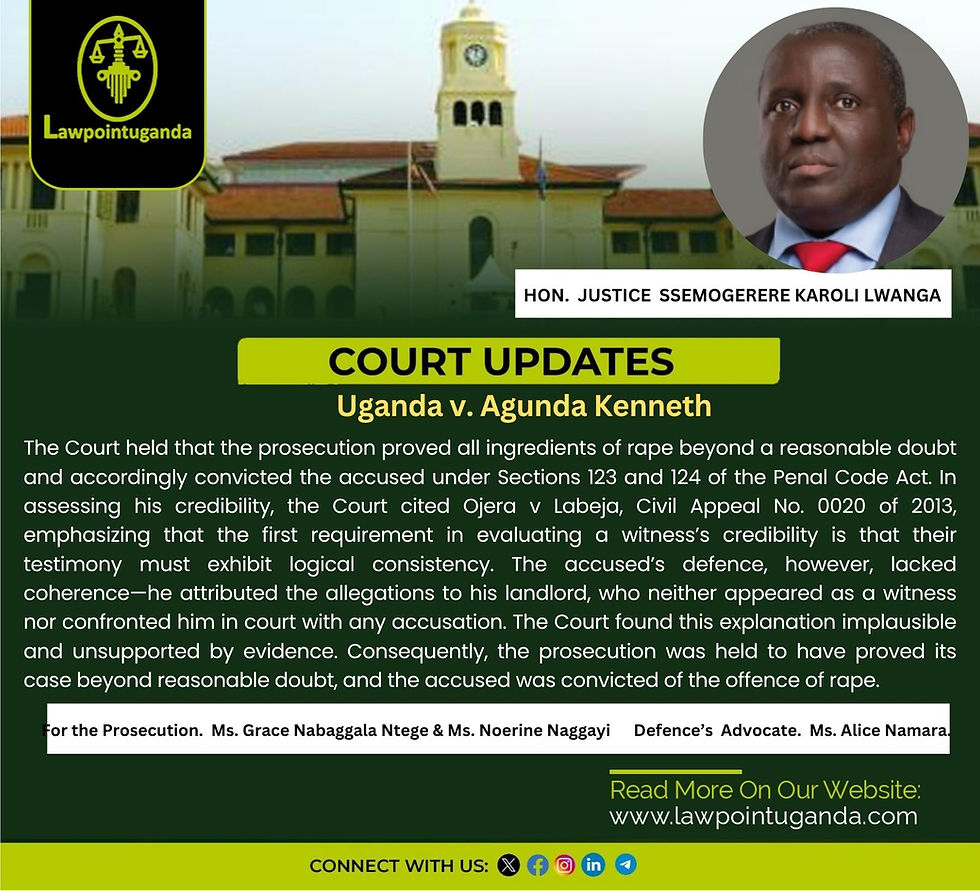
For the Prosecution, Ms. Grace Nabaggala Ntege, Chief State Attorney; Ms. Noerine Naggayi, State Attorney (Kabale).
For the Accused, Ms. Alice Namara.
COURT’S FINDINGS
Hon. Justice Ssemogerere Karoli Lwanga reaffirmed that in criminal cases, the burden of proof lies entirely on the prosecution and never shifts to the accused, citing Ssekitoleko v Uganda [1967] EA 531 and Miller v Minister of Pensions [1947] 2 All ER 372.
The Court, agreeing with the assessors' joint opinion, systematically evaluated each ingredient of the offence, emphasizing the prosecution's unshifting burden under Section 105(b) of the Evidence Act (Miller v. Minister of Pensions [1947] 2 All ER 372) and that conviction must be based “on the strength of the prosecution’s case and not the weakness of the defence” (Ssekitoleko v. Uganda [1967] EA 531; Uganda v. Ogama CSC 0034 of 2016).
Proof of Sexual Intercourse
Proven via medical evidence and testimony.
“There was sexual intercourse as proved by the PF3A, in PEX1 in the memorandum of agreed facts. The evidence of penetration, i.e. the no hymen and lacerations on her vulva on PF Form 3A, is recorded. PW1, the victim, told court in detail what happened on the fateful day... The evidence of sexual intercourse was also corroborated by PW3, whom she told the same. PW3 told court she found her daughter, the victim, had blood stains on her body and her clothes.”
The Court noted that this finding aligned with Uganda v. Odwong Dennis and Olanya Dickson [1992–93] HCB 71.
Lack of Consent
Established due to the victim's age (14, below 18).
“Lack of consent. The age of the victim, 14 years old, is below the age of consent in Uganda, which is 18 years.”
The assessors echoed:
“In respect of lack of consent, they told court the use of violence and details of the act showed the victim did not consent to the encounter.”
Use of Force, Threat, or Coercion
Supported by the victim’s (AA’s) account of violence and resulting injuries.Quote:
“Use of force. PW1’s testimony was to the effect that the accused forcefully entered the latrine with her, pulled up her clothes, pulled down her undergarments, grabbed her by the neck, and covered her mouth before forcibly having sex with her. He then threatened her not to tell anyone. The act itself was violent and left her with injuries on her genitals (vulva) showing lacerations on the PEX1, Police Form 3A.”
The assessors stated:
“In respect of use of force, the assessors found this evidence sufficiently corroborated by the injuries PW3 found on the victim, and the PEX3 proving use of force.”
Participation of the Accused
Confirmed by identification, opportunity, and partial admissions.Quote:
“Participation of the accused. The act occurred at around 4 p.m., during the hours of daylight. PW1, the victim, had interacted with the accused person, DW1, for about one hour at her aunt PW2’s place... This was not a case of mistaken identity or unfavourable circumstances for identification. Rather, it was a crime of opportunity, preying on an innocent under-age victim.”
The Court highlighted inconsistencies in the defence, noting the accused’s own admissions during cross-examination:
“In your statement, you told Police you directed the victim to the toilet? Yes.”“You were in close contact with the victim? Is this correct? True, it is correct.”
The assessors further observed:
“The accused participated in the act. He was present in the sitting room when the victim came with her aunt. DW1 also admitted showing the victim the way to the toilet. The time of the offence, in their conclusion, removed the risk of any mistaken identity.”
Credibility Assessment
The Court deemed the prosecution witnesses “credible and believable” and found “sufficient corroboration” in their testimonies and documentary evidence.Conversely, the defence was described as “a half-hearted denial” lacking “logical consistency,” consistent with the standard in Ojera v. Labeja, Civil Appeal No. 0020 of 2013.
Holding
The Court held that the prosecution had proved all the essential ingredients of the offence beyond reasonable doubt, and accordingly convicted the accused of rape under Sections 123 and 124 of the Penal Code Act, Cap 128.
“I accordingly find the prosecution has proven its case beyond a reasonable doubt. The findings on all ingredients are sufficiently corroborated. This was a crime of opportunity. The accused had the opportunity to prey on an innocent victim who could not fight him off. The prosecution has met the legal and evidentiary burdens and proved its case beyond a reasonable doubt. I accordingly convict the accused of the offence of rape c/s 123 and 124 of the Penal Code Act, Cap 128.”
KEY TAKEAWAYS
Burden of Proof
The prosecution must prove every element of rape beyond reasonable doubt. The accused’s denial does not shift this burden.
Strict Liability on Age of Consent
Sexual intercourse with a person below 18 years constitutes rape or defilement, irrespective of purported consent.
Corroboration through Medical Evidence
PF3 forms provide critical corroboration of penetration, force, and injury in sexual offences.
Credibility and Logical Consistency
Testimonies must align logically and factually; incoherent defences weaken credibility (Ojera v Labeja, Civil Appeal No. 20 of 2013).
Community Risk Awareness
The case highlights risks of sexual exploitation by trusted or familiar neighbours emphasising the importance of vigilance and education.
DATA PROTECTION AND PRIVACY: MAINTAINING ACCESS TO JUSTICE
This judgment also emphasises the importance of privacy and data protection in the administration of justice, especially in sexual offence cases.
While justice demands transparency, the privacy and dignity of victims must remain paramount. The High Court’s anonymisation of the victim as “AA” aligns with the Data Protection and Privacy Act, ensuring:
Protection of personal and medical data;
Restricted access to sensitive records;
Anonymised judgments for public use; and
Safe digital and physical record-keeping within the justice system.
This approach reflects Uganda’s emerging balance between open justice and personal data protection, ensuring that victims can seek justice without fear of re-traumatisation or public exposure.
Read the full case


.jpg)

Comments