
Court of Appeal clarifies that the limitation period for recovery of land starts running from the date of eviction, not from the date of an earlier transfer or occupation by another party.

Background
Bwire Stephen (Appellant) sued Nakirya Fulumela (Respondent) in the Chief Magistrate’s Court of Pallisa, alleging trespass and seeking eviction from the suit land. Bwire claimed he was raised on the land by his grandparents and, after their death, was under Nakirya’s custody. He alleged Nakirya sold portions of the land, including his share, and evicted him.
Nakirya denied the trespass claim, asserting she received the suit land as a gift inter vivos from her father, Erika Madunda, in 1970 before his death. She claimed beneficial ownership, having lived on the land for over 30 years with her mother, Asanasi Akia. Nakirya argued Bwire was a trespasser, not a son of Madunda, and that his claim was time-barred.
The Chief Magistrate found the suit land was part of Madunda’s estate and that both Bwire and Nakirya were his grandchildren. The court apportioned 9 acres to Nakirya and 1 acre to Bwire, including the area with graves of Bwire’s family members.
Nakirya appealed to the High Court, which overturned the Magistrate’s decision. Justice Henry Kaweesa held that the Magistrate erred in finding Bwire entitled to the land, deemed the suit time-barred, and criticized the failure to visit the locus in quo. The High Court set aside the trial court’s orders, granting Nakirya uninterrupted use of the land and ordering Bwire to pay costs.
Dissatisfied, Bwire appealed to the Court of Appeal, raising four grounds:
The High Court erred in holding he had no right to the land.
The High Court erred in finding his suit time-barred.
The High Court erred in holding that the failure to visit the locus in quo caused a miscarriage of justice.
The High Court’s decision was tainted by fundamental misdirection and non-direction, leading to a miscarriage of justice.
Issues
The Court of Appeal, led by Justice Luswata, addressed the following key issues:
Whether Bwire’s suit was barred by limitation under Section 5 of the Limitation Act.
Whether Bwire had a legal right to the suit land, either through customary tenure, inheritance, or adverse possession.
Whether the trial court’s failure to visit the locus in quo occasioned a miscarriage of justice.
Whether the High Court’s decision was fundamentally misdirected in law and fact.
Submissions of the Parties
Appellant’s Submissions
Ground 1 (Right to the Land)
Bwire’s counsel argued that Bwire, as Madunda’s grandson, had a customary or inheritance-based right to the land, supported by the presence of his relatives’ graves. Alternatively, Bwire’s uninterrupted use of the land for over 15 years established rights via adverse possession.
Ground 2 (Limitation)
Counsel contended that the suit was not time-barred, as Bwire’s cause of action arose in 2008 when Nakirya evicted him, not in 1970. The suit, filed in 2009, was within the 12-year limitation period under Section 5 of the Limitation Act. Counsel cited Veronica Nakiyingi v. Michael Nsobani to argue that trespass claims fall outside the limitation period for land recovery.
Ground 3 (Locus Visit)
Counsel argued that a locus visit was not mandatory, as the presence of graves was undisputed, and no boundary issues arose. The Magistrate’s apportionment was fair, and the High Court’s finding of a miscarriage of justice was erroneous.
Ground 4 (Misdirection)
Counsel claimed the High Court’s decision was broadly flawed, causing a miscarriage of justice, though specific errors were not detailed.
Respondent’s Submissions
Ground 1:
Nakirya’s counsel argued that the suit land was gifted to her by Madunda, supported by witnesses, and that Bwire, not being a lineal descendant, had no claim. The Magistrate erred in awarding Bwire a portion of land already sold to another party (Madundu), who was not sued.
Ground 2:
Counsel supported the High Court’s finding that Bwire’s claim was time-barred, as Nakirya’s ownership dated back to 1970, exceeding the 12-year limitation period.
Ground 3:
Counsel argued that a locus visit was necessary to verify the land’s features and Bwire’s claims, and the Magistrate’s failure to do so prejudiced Nakirya.
Ground 4:
Counsel did not specifically address this ground but maintained that the High Court’s decision was sound.
Court’s Findings
In the lead judgement of Justice Luswata
Ground 2: Limitation
Justice Luswata examined Section 5 of the Limitation Act, which bars recovery actions after 12 years from accrual of the cause of action.
“Bwire was evicted in July 2008. It is only in 2008 that his right to sue Nakirya would accrue and not before. Filing suit in January 2009 was within the statutory period and the claim was not time-barred.”
The Court faulted the High Court for presuming that limitation began to run as far back as 1970.
The High Court erred in holding Bwire’s suit time-barred. Bwire’s claim was for trespass, not solely land recovery, and his cause of action accrued in July 2008 when Nakirya evicted him. Filing the suit in January 2009, within one year, was well within the 12-year limitation period under Section 5 of the Limitation Act. The Magistrate’s decision to hear the case was correct.
Ground 2 succeeded.
Ground 1: Right to the Land
Justice Luswata upheld the High Court’s finding that Bwire failed to establish a legally enforceable right in the suit land.
The evidence strongly supported that Nakirya received the land as a valid gift inter vivos, perfected through exclusive possession since the 1970s.
The Court cited Oyet Bosco & Another v Abwola Vincent (HCT Civil Appeal No. 68 of 2016), affirming that customary gifts can be proved by long possession and use.
Bwire’s mere presence on the land and the existence of family graves did not translate into a customary tenure right or legal entitlement.
“Permitting him to bury some of his children and his mother on the suit land was not enough to support his claim to it, as Madunda’s grandson.”
This ground failed.
Ground 3: Locus Visit
Justice Luswata stressed the importance of locus visits in land disputes under Practice Direction No. 1 of 2007.
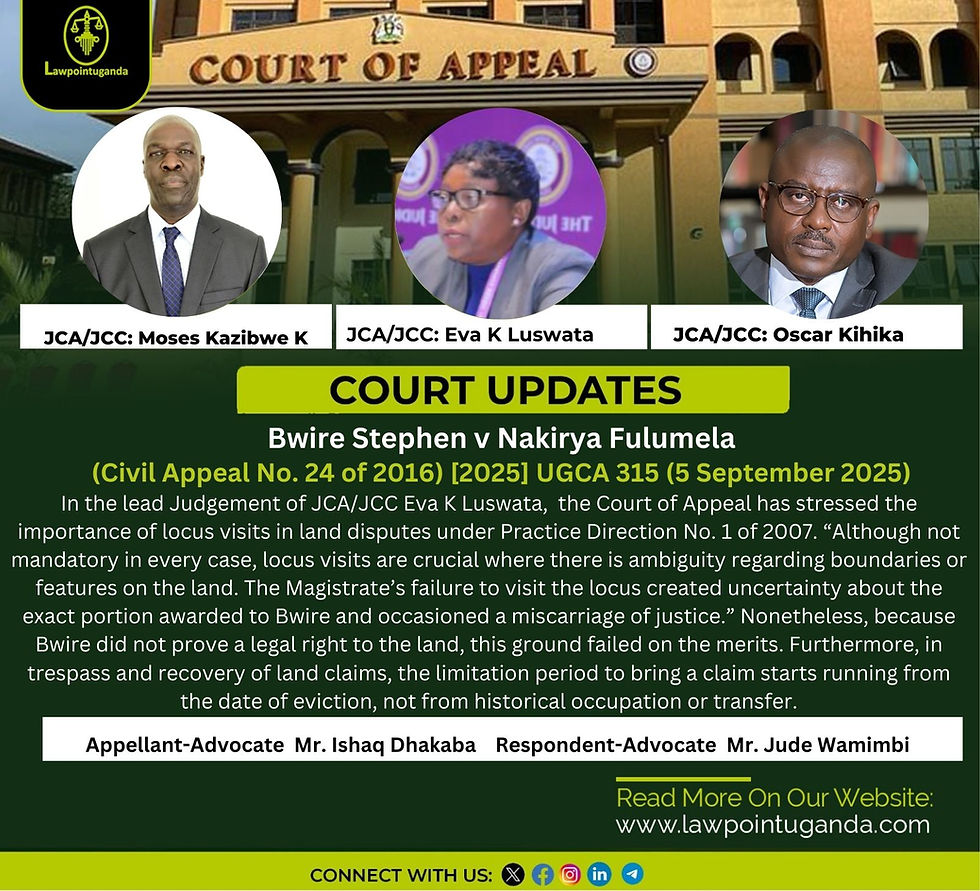
“Although not mandatory in every case, locus visits are crucial where there is ambiguity regarding boundaries or features on the land. The Magistrate’s failure to visit the locus created uncertainty about the exact portion awarded to Bwire and occasioned a miscarriage of justice.”
Nonetheless, because Bwire did not prove a legal right to the land, this ground failed on the merits.
The trial court’s failure to visit the locus in quo was a procedural error. A visit was necessary to clarify the size, location, and features of the disputed land, especially given Bwire’s ambiguous claim to a portion of the 10 acres. The Magistrate’s arbitrary award of 1 acre without a locus visit led to an unclear and unenforceable judgment, causing a miscarriage of justice.
Ground 4: Misdirection
This ground was struck out for violating Rule 86(1) of the Court of Appeal Rules, as it was vague and failed to specify particular errors in the High Court’s decision. It merely repeated arguments from the other grounds and was deemed an omnibus challenge.
The Court struck out this ground for being omnibus and non-compliant with Rule 86(1) of the Court of Appeal Rules.
“This ground is a vague contest against the judgment in general and cannot stand.”
Ground 4 failed.
Holding
The Court of Appeal dismissed Bwire’s appeal, upholding the High Court’s decision to grant Nakirya uninterrupted use of the suit land. However, considering Bwire’s status as a self-represented litigant and the familial nature of the dispute, the court declined to award costs to Nakirya, ordering each party to bear their own costs.
Key Principles
Limitation Period for Trespass Claims
The court clarified that the limitation period under Section 5 of the Limitation Act applies to actions for land recovery, but a trespass claim’s limitation period begins when the cause of action accrues (e.g., eviction). This distinguishes trespass from recovery claims and emphasizes the importance of identifying the precise cause of action.
Customary Land Gifts (Inter Vivos):
A gift inter vivos of customary land does not require written documentation. Proof of exclusive occupation and use for an extended period (e.g., 33 years) can establish such a gift, as seen in Nakirya’s case.
Burden of Proof for Inheritance Claims:
Claimants asserting inheritance rights to customary land must provide strong evidence, especially if not lineal descendants. Bwire’s blood relation and residence were insufficient without proof of entitlement.
Locus Visits in Land Disputes:
While not mandatory, locus in quo visits are critical in land disputes to verify evidence, clarify boundaries, or confirm physical features. Failure to conduct such a visit may result in a miscarriage of justice, particularly when claims are ambiguous.
Read the full case


.jpg)

Comments