
Supreme Court Holds That Where a Public Authority Defers, Rather Than Refuses, Performance of Its Duty, the Rule 5(1) Judicial Review Limitation Period Runs From the Final Administrative Decision.

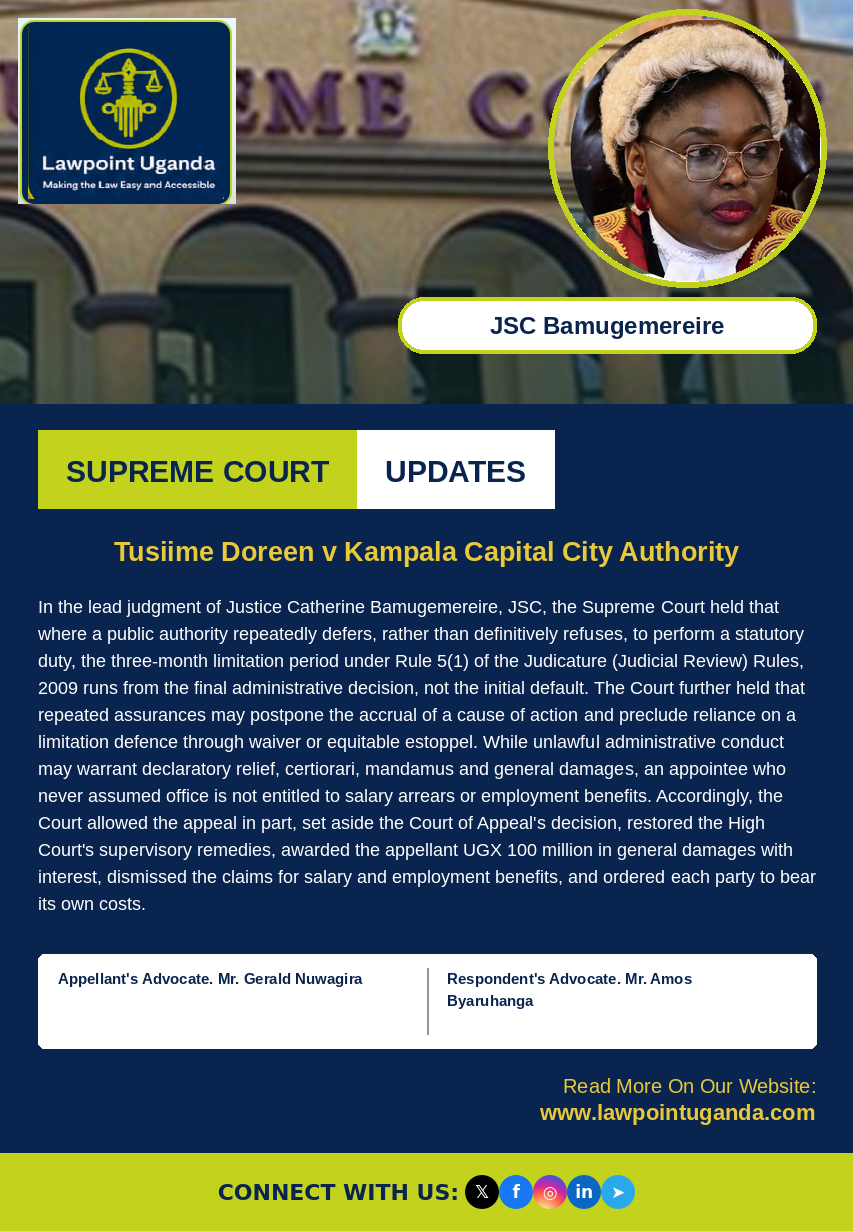
Supreme Court Holds That Where a Public Authority Defers, Rather Than Refuses, Performance of Its Duty, the Rule 5(1) Judicial Review Limitation Period Runs From the Final Administrative Decision, Not the Initial Default.
OVERVIEW
In a judgment delivered on 28 July 2026, the Supreme Court of Uganda set aside a decision of the Court of Appeal that had held a judicial review application filed by a public officer appointee to be time-barred. Writing for a unanimous coram, Bamugemereire, JSC held that where a public authority repeatedly defers the deployment of a validly appointed officer while making ongoing assurances that deployment will follow, the limitation period under Rule 5(1) of the Judicature (Judicial Review) Rules, 2009 does not begin to run until the authority communicates a definitive, final refusal.
The Court further held that an appointee who never commenced duty cannot recover salary arrears or NSSF contributions, but may nonetheless be entitled to general damages for the administrative wrong suffered. The decision carries significant implications for public bodies that manage appointment backlogs through informal deferrals rather than formal decisions.
FACTS
The appellant, Ms Tusiime Doreen, applied for the position of Officer Prosecution at the respondent, Kampala Capital City Authority ("KCCA"), following a 2012 recruitment exercise conducted by the Public Service Commission. She was successful and was notified of her appointment by letter dated 1 October 2012, with instructions to report to KCCA's Executive Director for deployment.
Upon reporting, the appellant was verbally informed by the Director of Human Resources that her deployment had been halted for want of funds, and that she should await the next financial year. Similar communications recurred in the 2013/2014 and 2014/2015 financial years, each citing continued budgetary constraints. It was noted that no formal refusal was issued during this period; rather, the appellant was repeatedly assured that deployment remained pending.
By letter dated 6 October 2016, KCCA formally notified the appellant that her deployment was halted sine die on account of persistent financial constraints. The appellant filed an application for judicial review in the High Court on 18 October 2016, twelve days later, seeking certiorari to quash the decision, mandamus to compel her deployment, and compensation equivalent to the salary and benefits she would have earned from the date of her appointment.
The High Court found in her favour, granting certiorari and mandamus and awarding damages equivalent to the net salary she would have earned from the date of notification of appointment, together with costs. On appeal, the Court of Appeal reversed the High Court in its entirety, holding that the application was time-barred, and dismissed the appellant's cross-appeal on damages and entitlements. It was this decision that came before the Supreme Court.
The appellant was eventually deployed on 1 April 2019, after she had initiated contempt proceedings to enforce the High Court's original order — a delay of nearly two years from the date of that order. It was submitted that other officers with comparable complaints against KCCA had, during the same period, secured consent judgments under which they were promptly deployed and paid costs, salary arrears, and NSSF benefits.
The Court noted that, as a second appellate court, its role was not ordinarily to re-evaluate evidence or disturb concurrent findings of fact, save where the lower courts had failed to evaluate the evidence or were shown to be manifestly wrong, and that judicial review, being a distinct procedural pathway, required particular caution in the exercise of this second-appellate function.
LEGAL REPRESENTATION
Mr Gerald Nuwagira appeared for the appellant, and Mr Amos Byaruhanga appeared for the respondent. Both counsel informed the Court that written submissions had been filed and requested that the Court adopt them in reaching its decision.
SUBMISSIONS
For the Appellant
Counsel for the appellant argued Grounds 1 and 2 together. It was submitted that the decision halting the appellant's deployment sine die was formally communicated only by the letter of 6 October 2016, and that the judicial review application, filed on 18 October 2016, was lodged within fourteen days of that decision and well within the prescribed time. Counsel contended that, prior to that letter, the appellant had consistently been told that her deployment was merely deferred, so that no final decision existed capable of being challenged until the communication of 6 October 2016. It was submitted that the cause of action crystallised only upon that communication.
It was further submitted that KCCA had failed to comply with its mandatory duty under Regulation 29(1) of the Public Service Commission Regulations, which requires deployment of an appointed officer within one month of notification, and that this omission amounted to an illegality which, relying on Makula International Ltd v Cardinal Nsubuga & Another (1982) HCB, could be challenged at any time and could not be sanctioned by the Court.
On Ground 3, counsel submitted that KCCA had failed to comply with the High Court's deployment order and only acted after the appellant initiated contempt proceedings, leaving her unemployed for a prolonged period while comparably placed officers had their matters expeditiously resolved by consent judgment, with prompt deployment and payment of costs, salary arrears, and NSSF benefits. It was submitted that this disparate treatment amounted to a violation of the appellant's right to equal and fair treatment, warranting enhanced damages.
Counsel further submitted that the trial judge had misconstrued the sums claimed as general compensation when they were, properly understood, salary arrears constituting accrued entitlements recoverable as special damages, and that the trial judge had additionally erred by failing to consider general, exemplary and aggravated damages separately pleaded, said to total UGX 800,000,000. It was prayed that KCCA be directed to pay salary arrears from 1 October 2012 to 31 March 2019 and to remit the appellant's NSSF contributions, and that the cross-appeal be allowed in full with costs.
In reply, counsel for the appellant contended that KCCA, through its conduct and correspondence, had waived the limitation defence and was precluded by equitable estoppel from relying on it, citing Lubowa & 4 Ors v Makerere University [2013] UGSC 8. It was also submitted that the constitutional violations relied upon had in fact been pleaded in the Notice of Motion before the High Court and ought to have been considered by the Court of Appeal.
For the Respondent
Counsel for the respondent, arguing Grounds 1 and 2 together, submitted that the Court of Appeal had correctly evaluated the evidence and the law on continuous torts, relying on Attorney General v Gen. David Sejusa, CACA No. 196 of 2015, for the proposition that a cause of action becomes actionable as a breach of statute upon expiry of the prescribed period, such that no continuous tort arose once the statutory period for issuing the appointment letter had lapsed.
It was submitted that the appellant's constitutional argument had not been canvassed before the Court of Appeal and ought not to be entertained at this stage, relying on Sumbu Jean Louis v Uganda, SCCA No. 77 of 2019, and that an illegality-based cause of action was, in any event, equally subject to limitation. Counsel submitted that judicial review applications were required to be filed within three months, that is, by January 2013, and that the appellant's application, filed in October 2016 without leave to file out of time, was accordingly time-barred, as the Court of Appeal had correctly found.
On Ground 3, it was submitted that once the Court of Appeal allowed KCCA's appeal and set aside the entire High Court decision, the cross-appeal became moot and was properly dismissed. Without prejudice to that submission, counsel further argued that the appellant, never having commenced employment, was not entitled to salary, NSSF contributions or other employment benefits, which accrue only upon the rendering of service, relying on Rugundu v International Law Institute [2006] UGSC 18 and Bank of Uganda v Betty Tinkamanyire [2008] UGSC 21. It was also submitted that the appellant had failed to prove loss or mitigation as required by Decro Wall International SA v Practitioners in Marketing Ltd [1971] 1 WLR 361, and that the appeal ought to be dismissed with costs.
COURT'S FINDINGS
On Limitation
The cause of action accrued only upon KCCA's final decision in October 2016
The Supreme Court rejected the Court of Appeal's conclusion that limitation began running in 2012. The Court observed that the issue was when all material facts crystallised into an enforceable legal claim.
Justice Bamugemereire held:
"The inquiry... is not abstract but fact-sensitive and requires the Court to identify the moment when the claimant's right of action crystallised into an enforceable claim."
The Court noted that until October 2016, KCCA had never communicated a definitive refusal to deploy the appellant. Instead, it repeatedly assured her that deployment would occur when funds became available.
The Court therefore held that the letter dated 6 October 2016 constituted the operative administrative decision giving rise to the cause of action.
The Court noted that;
apart from any special provision, a cause of action normally accrues when there is in existence a person who can sue and another who can be sued, and when there are present all the facts which are material to be proved to entitle the plaintiff to succeed. Halsbury's Laws of England, 4th Edition, Vol. 28, para. 622, cited with approval
Applying this to the facts, the Court held that between 2012 and 2016 KCCA had not issued a definitive refusal to deploy the appellant, but had repeatedly deferred her deployment pending the availability of funds. It was only the letter of 6 October 2016 that constituted, in the Court's words, the operative administrative decision underpinning the cause of action.
The various studies and reports indicate to me that until a final decision was made, the parties did not have all the facts necessary to commence legal proceedings... In my considered view, all the material facts necessary to constitute a cause of action were not present while all these studies and exercises were going on since no final position had been made by the responsible organ of the respondent. Applying Lubowa & 4 Others v Makerere University [2013] UGSC 8,
The Court held that KCCA's repeated assurances reasonably led the appellant to refrain from litigating earlier, and that it would be inequitable, in those circumstances, to permit KCCA to invoke the defence of limitation. It found support for this conclusion in National Insurance Corporation v Span International Ltd (Civil Appeal No. 13 of 2002) [2004] UGCA 44, and in the House of Lords' reasoning in Kammins Ballrooms Co Ltd v Zenith Investments Ltd [1970] 2 All ER 871, on the principle that a party who leads another to believe that strict legal rights will not be enforced may be precluded from later insisting on them.
The Court noted the Court of Appeal's approach, which had treated the limitation period as running from the moment KCCA first failed to deploy the appellant in 2012, such that later assurances could not suspend or extend time.
I find that the Court of Appeal's decision runs afoul of the body of precedent when it concluded that the appellant's action was barred by limitation... Deeming the claim time-barred would prioritise procedural rigidity over substantive justice contrary to article 126(2)(e) of the Constitution of Uganda (1995).
On the nature of the wrong, the Court held that where a public authority continues to withhold or delay execution of a valid appointment, this constitutes an ongoing administrative omission rather than a single completed act, so that limitation does not run until the authority's conduct explicitly indicates that no appointment will be honoured. It was noted, however, that deferred deployment is permissible only as a temporary and reasonable administrative expedient, and cannot lawfully be used to extinguish vested rights or perpetuate uncertainty over an officer's tenure.
Accordingly, the Court held that the application was not time-barred, that certiorari and mandamus had properly been granted by the High Court, and that the Court of Appeal had erred in setting these remedies aside. Ground 2 was allowed.
On the Cross-Appeal and Remedies (Ground 3)
The Court held that, the cross-appeal being contingent on the judgment it sought to vary, the appellant's complaint that the cross-appeal had been overlooked could not stand once the underlying issues had been determined with finality, distinguishing Galleria in Africa Limited v Uganda Electricity Distribution Company Limited [2018] UGSC 102 and relying on Kifamunte Henry v Uganda, SCCA No. 10 of 1997, for the principle that appellate remedies must rest on a valid decision.
On entitlement to benefits, the Court held that employment benefits, including salary and NSSF contributions, accrue only upon commencement of service, following Rugundu v International Law Institute and Bank of Uganda v Betty Tinkamanyire, and that damages must be demonstrably proven with efforts at mitigation shown, per Decro Wall International SA v Practitioners in Marketing Ltd. The appellant's reliance on the treatment of colleagues who had secured consent judgments was found unpersuasive, the Court observing that each case turns on its own facts.
Nonetheless, the Court held that courts retain discretion to grant appropriate relief where a wrong is proved, and found that KCCA's administrative error warranted compensation by way of general damages, notwithstanding that salary arrears and employment benefits were excluded.
To award salary or allowances for a period in which no service was rendered would amount to unjust enrichment and would contradict the principle that remuneration flows from service.
HOLDING
The Supreme Court unanimously held as follows:
The appellant's judicial review application was not time-barred; the cause of action arose from a continuing administrative omission and crystallised only upon KCCA's letter of 6 October 2016.
The Court of Appeal erred in law in holding the application time-barred, and its decision was set aside.
Declaratory and supervisory relief was granted, affirming that the appellant's appointment was valid and that KCCA's failure to act was unlawful.
The appellant was not entitled to salary arrears, NSSF contributions or other employment benefits, having never commenced duty.
The appellant was awarded general damages of UGX 100,000,000, with interest at 6% (court rate) from the date of the trial court's judgment, 4 April 2017, until payment in full.
Each party was ordered to bear its own costs, the appeal having succeeded only in part.
Madrama, JSC, delivering a separate concurring judgment, agreed on the limitation and estoppel findings, holding that a cause of action accrues when all material facts necessary to found a suit exist, and that KCCA's repeated assurances between 2012 and 2016 precluded reliance on the limitation defence for the period during which the appellant laboured under those assurances. Tuhaise, Musoke and Kibeedi, JJSC concurred fully with the lead judgment.
Key Takeaways
1. Limitation in judicial review begins when a final administrative decision crystallises
Where a public authority continually postpones implementation while assuring the affected person that action will be taken, the limitation period does not necessarily begin at the first administrative delay.
2. Continuing administrative omissions may postpone accrual of a cause of action
The Supreme Court recognised that prolonged administrative inaction accompanied by repeated assurances constitutes an ongoing administrative omission capable of delaying the commencement of limitation.
3. Public authorities may lose the benefit of limitation through waiver or equitable estoppel
A public body that repeatedly induces an individual to postpone litigation cannot later rely on limitation where its own conduct caused the delay.
4. Temporary administrative deferment cannot lawfully become indefinite
While financial or operational constraints may justify short-term deferments, they cannot be used to indefinitely suspend valid appointments or defeat legitimate expectations created by lawful appointments.
5. Appointment alone does not entitle an employee to salary
The decision reaffirms that salary, NSSF contributions and other employment emoluments accrue only upon the commencement of service. An appointee who never assumes office cannot recover wages for work not performed.
6. Judicial review can still attract compensatory relief
Although employment benefits were denied, the Court confirmed that general damages remain available where unlawful administrative conduct causes demonstrable injustice, even where the claimant never entered active service.


.jpg)

Comments