
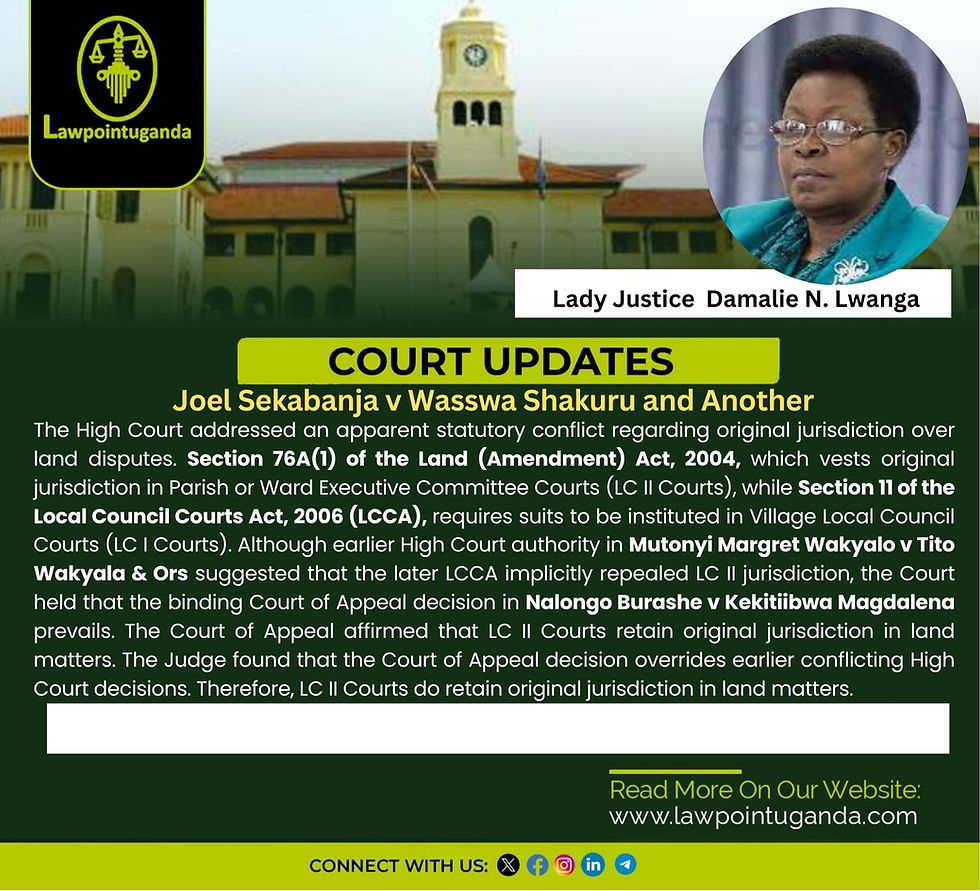
LC II Courts still have original jurisdiction over land disputes, pursuant to Section 76A of the Land Amendment Act (2004), as affirmed by the Court of Appeal. High Court Reaffirms

FACTS
The applicant, Joel Sekabanja, initiated a suit in the Lukwanga Local Council II Court against the respondents, Wasswa Shakuru (1st respondent) and Nakato Edith (2nd respondent), alleging trespass to a kibanja (customary land holding) located in Nabukalu Parish, Wakiso District.
The suit land was originally owned by the late Muwemba Matayo Kabunga, with the 1st respondent being his brother and the 2nd respondent his daughter and a beneficiary of his estate.
The LC II Court heard the matter as a court of first instance and delivered a judgment on 15th July 2022, ruling in favor of the respondents and declaring them the lawful owners of the suit kibanja.
Sekabanja then filed an application in the High Court under Sections 83(a) and 98 of the Civil Procedure Act, Section 40 of the Local Council Courts Act 2006, and Order 52 rules 1, 2, and 3 of the Civil Procedure Rules, seeking revision and quashing of the LC II Court's ruling.
He argued that the LC II Court lacked original jurisdiction, rendering its decision illegal, null, and void. The respondents opposed the application via affidavits, asserting that the LC II Court had proper jurisdiction over the trespass dispute and that the application was vexatious and an abuse of process.
Issues
The sole issue for determination by the High Court was;
Whether the Lukwanga LC II Court had jurisdiction to hear and determine the land dispute as a court of first instance.
SUBMISSIONS
Applicant’s Submissions
Counsel for the applicant argued that the LC II Court misdirected itself by hearing the case as a first-instance court, as jurisdiction in land matters is statutorily reserved for LC I Courts (village level). Relying on Section 10 of the Local Council Courts Act 2006, which outlines the jurisdiction of LC Courts in land matters, and Section 11, which mandates that suits be instituted in the village LC Court, counsel emphasized that jurisdiction is a creature of statute and cannot be self-conferred.
Regulation 32 of the Local Council Courts Regulations was cited to reinforce that suits must commence where the defendant resides, the cause of action arises, or the immovable property is located, starting at the LC I level.
The case of Mutonyi Margret Wakyalo v. Tito Wakyala & Ors [2011] UGHC 117 was cited, in which the High Court held that the Local Council Courts Act 2006 impliedly repealed provisions granting LC II Courts first-instance jurisdiction in land matters.
Counsel concluded that the LC II Court's decision should be revised, quashed, or set aside for lack of jurisdiction.
Respondents' Submissions
Counsel for the respondents contended that the LC II Court had jurisdiction under Section 10 of the Local Council Courts Act 2006 to handle disputes concerning trespass to land/kibanja. They noted that the applicant failed to specify the pecuniary value of the suit kibanja, which could affect jurisdictional limits. The facts of the cited Mutonyi case were distinguished as inapplicable to the present matter. Counsel argued that the application lacked merit, did not warrant revision, and should be dismissed as vexatious, with costs awarded to the respondents.
COURT’S FINDINGS
The Court conducted a detailed analysis of the Land Amendment Act, 2004, the Local Council Courts Act, 2006, and relevant precedents.
The High Court examined the application, affidavits, and submissions, focusing on the statutory framework governing the jurisdiction of Local Council Courts in land matters. In doing so, the Court identified a potential conflict between two legislative regimes:
Section 76A(1) of the Land (Amendment) Act 2004, which designates Parish or Ward Executive Committee Courts (equivalent to LC II Courts) as courts of first instance for land disputes; and
Sections 10 and 11 of the Local Council Courts Act 2006, which provide that all suits—including those involving land—must be instituted at the Village Local Council Court (LC I Court) as the court of first instance, a position further amplified by Regulation 32 and Section 32, which outline appeals from LC I to LC II Courts.
The Court reviewed the applicant’s reliance on Mutonyi Margret Wakyala v. Tito Wakyala & Others [2011] UGHC 117, in which Musota J. held that the Local Council Courts Act 2006 impliedly repealed Section 76A of the Land Act, thereby restoring original jurisdiction to LC I Courts. The High Court noted the following key excerpts from Musota J.’s reasoning:
“Regarding the second question raised by the learned Chief Magistrate, this has to be considered in light of the enactment of the Local Council Courts Act… vis-à-vis Section 76A of the Land Amendment Act 2004 which gave the LC II Courts power to handle land matters as courts of first instance. There appear to be concurrent powers in land matters given to both the LC II Courts under the Land Amendment Act and LC I Courts under the Local Council Courts Act because the latter Act did not expressly repeal the former.”
And further:
“It is my considered view that this absurdity can be resolved by applying the principles of statutory interpretation and rules which govern legislative drafting. It is trite law that where an earlier statute is in conflict with a later one, the later statute prevails… Consequently, I will hold that LC II Courts no longer have jurisdiction in land matters as courts of first instance.”
However, the High Court ultimately followed the binding authority of the Court of Appeal in Nalongo Burashe v. Kekitiibwa Mangadalena, Civil Appeal No. 89 of 2011, which upheld the original jurisdiction of LC II Courts in land disputes. The Court of Appeal endorsed the position of Bashaija J. in Busingye Jamiya v. Mwebaze Abdu and Another, High Court Civil Revision No. 033 of 2011, applying the Interpretation Act and affirming that provisions of the Local Council Courts Act operate subject to other written laws, including the Land Act. Key excerpts adopted by the Court include:
“It is my view that the provisions of the Land Act were intended to modify the provisions of the Executive Committee (Judicial Powers) Act… with regard to jurisdiction over land disputes and the forum of appeals from Division or Sub-County Executive Committee Courts.”
And:
“Accordingly, a Local Council Court established at the village level has no jurisdiction to try and determine land disputes or matters relating to land. Section 76A(1) and (2) of the Land Act must be read with the necessary modifications in light of the changes in the names of courts established under the Local Council Courts Act, 2006.”
Relying on the Court of Appeal’s interpretation, the High Court held that the statutory conflict is resolved in favour of LC II Courts having original jurisdiction in land matters.
HOLDING
The LC II Court of Lukwanga had jurisdiction to hear the land matter as a court of first instance.
The application for revision is dismissed.
Costs were awarded to the respondents.
KEY TAKEAWAYS
LC II Courts still have original jurisdiction in land disputes, pursuant to Section 76A of the Land Amendment Act (2004) and affirmed by the Court of Appeal.
Earlier High Court decisions suggesting LC I Courts exclusively hold first-instance jurisdiction are overridden by the Court of Appeal’s binding authority.
Litigants cannot rely on an alleged jurisdictional error where the law clearly empowers LC II Courts to hear land matters.
When statutes appear conflicting, courts will apply a harmonised interpretation and consider later Court of Appeal rulings.
Filing a suit in LC II and later contesting its jurisdiction may weaken the applicant’s position, especially where the law supports LC II authority.
This ruling reinforces the hierarchical clarification of LC Court jurisdiction, reducing uncertainty in land dispute resolution at the community level.
Read the full case


.jpg)

Comments