
High Court Rules Nomination and Qualification Complaints Are Not Pre-Election Matters, Strikes Out Restricted Polling Station Complaint, and Expunges 97 Supplementary Affidavits Filed Without Leave

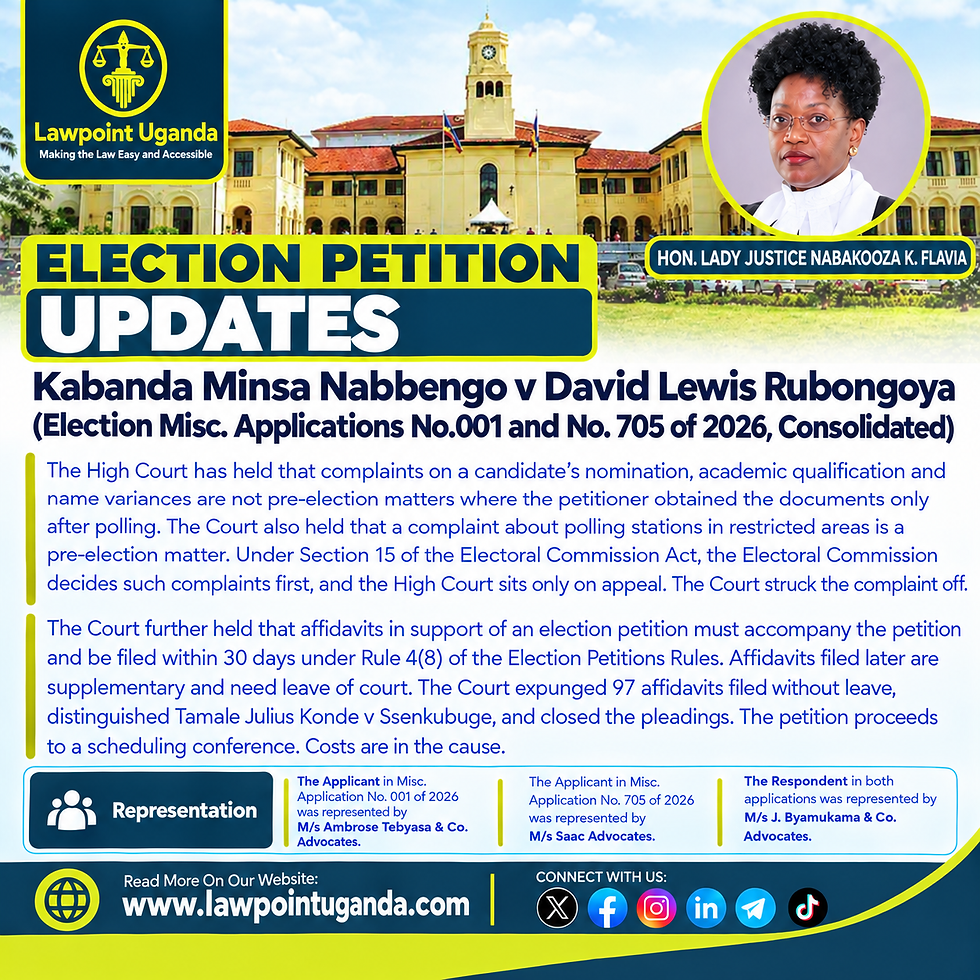
Kabanda Minsa Nabbengo v David Lewis Rubongoya; Electoral Commission v David Lewis Rubongoya
Election Misc. Applications No. 001 and No. 705 of 2026 (Consolidated), arising from Election Petition No. 10 of 2026 [2026] UGHCCD 298 | High Court of Uganda at Kampala | Nabakooza K. Flavia, J | 7 October 2026
Facts
Kabanda Minsa Nabbengo was declared and returned as the directly elected Member of Parliament for Kampala Central Division after the 15 January 2026 election, which had 16 candidates. David Lewis Rubongoya, a losing candidate, petitioned against her and the Electoral Commission on 30 March 2026 (Election Petition No. 10 of 2026). Answers were filed in April 2026 and no rejoinder followed.
The petition alleged that the Applicant was invalidly nominated, lacked the required academic qualifications and had name variances in her documents. He said he asked the Commission for her nomination papers before polling and received them only on 26 February 2026. He also alleged that 23 polling stations were kept in the restricted security areas of Nakasero II and Kololo II, contrary to the 2010 order in Erias Lukwago v Electoral Commission, Misc. Cause No. 113 of 2010.
In June 2026 (16 and 17 June, in Volumes 1 to 3) the Petitioner filed 97 affidavits in support of the petition, and one more on 21 August 2026, all without leave. Ms Nabbengo (Misc. App. 001/2026) and the Electoral Commission (Misc. App. 705/2026) applied to strike out the pre-election complaints and the affidavits. The Court consolidated the applications on 1 October 2026.
Legal Representation
Applicants
Misc. App. 001/2026: M/s Ambrose Tebyasa & Co. Advocates.
Misc. App. 705/2026: M/s Saac Advocates.
Respondent (both applications): M/s J. Byamukama & Co. Advocates.
Submissions of the Parties
The Applicants
• Section 15 of the Electoral Commission Act and Article 61(1)(f) of the Constitution give the Commission first-instance power over complaints at any stage, with appeal to the High Court. Section 32 places the siting of polling stations in the Commission. Relying on Birungi Kobusingye v Nantaba, the Petitioner could not use a petition to bypass that route.
• Rule 4(8) of the Election Petitions Rules requires the petition to be accompanied by an affidavit stating the facts. Relying on Electoral Commission v Bakireke and Mutembuli v Nagwomu, later affidavits do not "accompany" the petition and are supplementary, so they need leave. The 30-day limit in the Parliamentary Elections Act is strict, and the bulk of new material, including charge sheets, prejudiced the Applicants, whose answers could no longer be amended.
The Respondent
• Striking out under Order 6 rules 28 to 30 CPR (applied by Rule 17) is for plain cases only (Mukisa Biscuit). The restricted-areas and nomination issues are questions of fact, and the Commission blocked early inspection of the nomination papers.
• The Lukwago order bound the Commission regardless of complaints. Under Article 126(2)(e) and Tamale Julius Konde v Ssenkubuge, affidavits filed before the scheduling conference need no leave. The 30-day period governs only the petition and its accompanying affidavit. The fourth prayer (closing pleadings) had no supporting ground.
Court’s Findings
Issue 1: nomination, qualifications and names. The Court noted that, under Nandagire v Katushabe, a petitioner who sat on a known nomination defect is estopped after the election, and that Nalubega v Kinyamatama permits a petition only where the defect could not have been discovered with reasonable diligence. Here the certified documents were issued on 26 February 2026, after polling, so the complaints could not have been handled as pre-election disputes. Answered in the negative.
Issue 2: restricted polling stations. Applying Ojera Christopher v Electoral Commission, section 15 is a complete code and the High Court has only appellate jurisdiction. The Court rejected the argument that this is a question of fact. Annexure K, the 15 December 2025 voter register, showed Kololo II and Nakasero II as gazetted electoral areas, and the Petitioner made no complaint before polling. The Court held it lacks original jurisdiction. Answered in the positive.
Issue 3: the 97 affidavits. Acknowledging the liberal approach in Besigye v Museveni (2001), the Court held that affidavits to accompany a petition must be filed with it within 30 days (Rule 4(8); section 79(3)). Following Mutembuli, later affidavits are supplementary and need leave. Tamale Julius Konde was distinguished because the court there permitted additional affidavits. Here the affidavits were designated as "in support" but were supplementary and filed without leave. Held irregular, bad in law and expunged.
Issue 4: closure of pleadings. Despite the Applicants’ silence on this prayer, the Court considered it on the merits. Under Rule 10(3), the law contemplates the petition, the answer and any rejoinder, with other pleadings only by leave. No application for leave was pending, so pleadings were closed.
HOLDING
The consolidated applications succeeded in part. The Court ordered that:
• Complaints on nomination, academic qualification and name differences are not pre-election matters and stand.
• The complaint on restricted polling stations (Nakasero II and Kololo II) is a pre-election matter and is struck off.
• The 97 affidavits and attachments filed on 16/06/2026 and 21/08/2026 are struck off and expunged from the record.
• Pleadings in Election Petition No. 10 of 2026 are closed and the petition proceeds to a scheduling conference on the pleadings properly on record.
• Costs are in the cause.
Key Takeaways
Petitioners must file the affidavit setting out the facts, and the list of documents, with the petition within 30 days. Evidence gathered later requires an application for leave, made promptly.
A petitioner who alleges the Commission obstructed pre-election inspection of nomination papers should be ready to prove that obstruction, since it is the basis for bringing nomination complaints after polling.
Complaints about the siting of polling stations fall within section 15 of the Electoral Commission Act. They should go to the Commission before polling, even where a prior court order is said to be disregarded.
For respondents, the ruling shows that applications to expunge late affidavits can succeed where the filing is supplementary in substance, whatever label it carries.
The scope of Tamale Julius Konde is narrowed. Filing additional affidavits before the scheduling conference without leave carries real risk in this Division.


.jpg)

Comments