
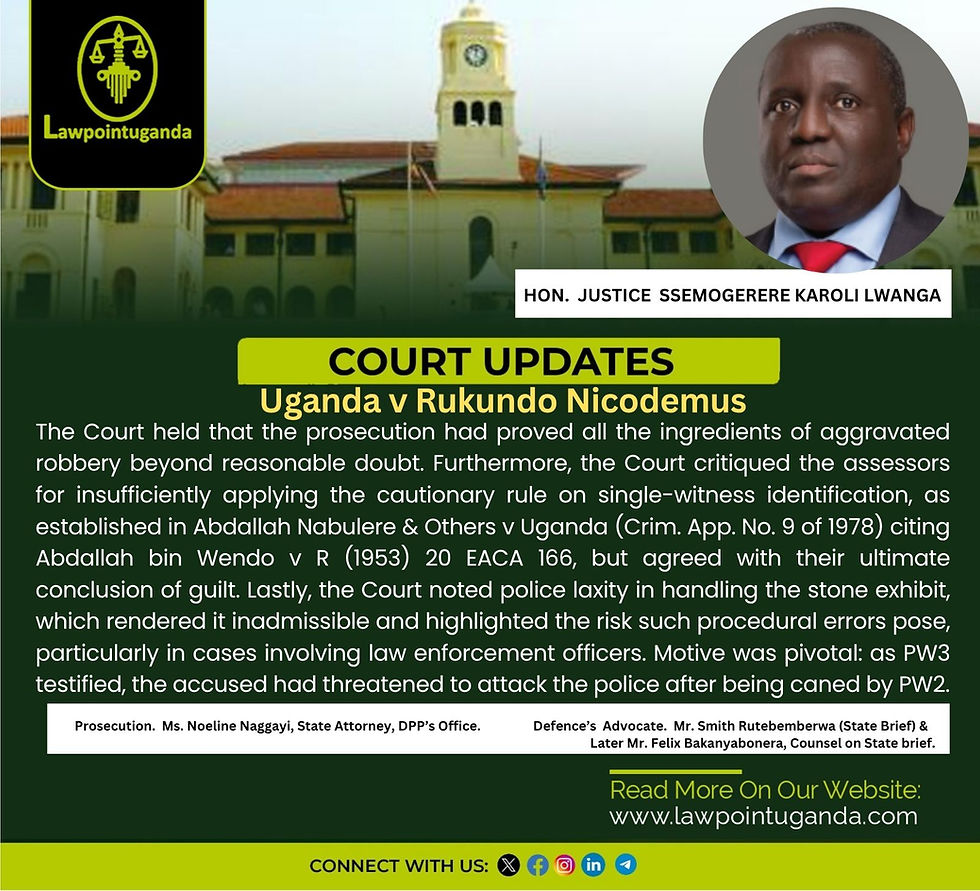
High Court at Kabale Convicts Boda Boda Rider for Aggravated Robbery of Police Officer in Kabale District

Facts
On 29 June 2021, during the COVID-19 lockdown curfew in Buhara Village, Kabale District, Assistant Inspector of Police (AIP) Turyahisanye Crescensio (aged 59), the Officer-in-Charge of Buhara Police Station, was enforcing business closures.
While advising a bar owner to shut down, he encountered resistance from patrons, including the Accused, Rukundo Nicodemus, a local boda boda rider known to him for two years.
The victim caned the Accused during the altercation, prompting the Accused to retort,
"For us we beat police officers, we shall see each other!"
En route home around 7:00 PM, the victim was accosted by the Accused and an unidentified accomplice under moonlight and phone light illumination. The Accused demanded and took UGX 200,000 in cash from the victim. Immediately after, the Accused struck the victim on the forehead and left eye with a stone (not a panga as initially alleged in the charge), causing him to fall.
The Accused then beat the victim further, inflicting severe injuries, including a lacerated forehead, upper left eyelid, and swollen, blood-filled left eye with permanent scarring and vision impairment.
The victim's phone was smashed nearby.
Two young men (Dennis and Albert) discovered the victim bleeding and alerted Buhara Police Station. A responding constable found him in a pool of blood, evacuated him first to a local health center (which referred him to Kabale Regional Referral Hospital), and recovered the stone. The Accused absconded from 29 June to 11 July 2021, when he was arrested while making chapati.
He was charged with aggravated robbery under Sections 266 and 267(2) of the Penal Code Act, Cap. 128, punishable by death for using a deadly weapon and causing grievous bodily harm to a police officer.
Prosecution evidence included;
Medical examination two weeks post-incident confirming grievous harm.
Victim's testimony on identification, robbery, and assault.
Eyewitness account of the bar altercation establishing motive.
Police response reports and exhibit recovery (stone, later inadmissible).
The Accused's defence was an alibi: he claimed to be home washing clothes at the time and denied involvement.
Issues
The primary issues before the Court were:
Whether the prosecution proved the ingredients of aggravated robbery beyond reasonable doubt, specifically:
(a) Theft of property (UGX 200,000);
(b) Use of violence or threat thereof to obtain/retain the property;
(c) Possession/use of a deadly weapon (panga or stone) at the time of, immediately before, or after the robbery; and
(d) The Accused's participation.
Reliability of single-witness identification under difficult conditions (nighttime, brief encounter, stress), given the victim's prior familiarity with the Accused.
Corroboration through motive evidence (bar altercation) and circumstantial indicators (absconding, injuries consistent with assault).
Admissibility and weight of exhibits (stone) amid police handling lapses.
Submissions
Prosecution Submissions (via witnesses):
PW2 (victim): Detailed the robbery sequence, identification via moonlight/phone light, prior knowledge of Accused as a boda boda rider, and injuries from stone assault (clarifying no panga was used).
PW1 (Police Surgeon): Corroborated grievous harm via Police Form 3A, noting lacerations, swelling, and severe trauma.
PW3 (bar eyewitness): Established motive, testifying to the caning and Accused's threat:
"For us we beat police officers, we shall see each other!"
PW4 and PW5 (police responders): Confirmed the scene (victim in blood pool, smashed phone), evacuation, and incident recording in the Station Occurrence Book (OB), with PW4 recovering the stone.
The prosecution urged conviction, arguing the ingredients were met through direct (victim) and circumstantial evidence, with identification reliable due to familiarity and lighting.
Defence Submissions;
The Accused (DW1) denied the charges, claiming an alibi of being home washing clothes at 7:00 PM. He admitted absconding but offered vague explanations.
On cross-examination, he conceded arrest details but offered no witnesses or corroboration.
Defence highlighted lack of panga recovery, poor stone handling (leading to inadmissibility), and challenged nighttime identification as unreliable.
The defence prayed for acquittal, asserting the alibi raised reasonable doubt and prosecution evidence was uncorroborated beyond a single witness.
Legal Representation
Prosecution; Ms. Noeline Naggayi, State Attorney, on behalf of the Director of Public Prosecutions.
Defence; Mr. Smith Rutebemberwa on state brief (Mr. Felix Bakanyabonera held brief at judgment reading).
Assessors; Ms. Mercy Kembabazi and Mr. Livingstone Ndyamutunga, who unanimously opined for conviction on 3 October 2025 after summation on 30 September 2025.
Court's Findings
The Court, evaluated evidence applying the prosecution's burden beyond reasonable doubt (Woolmington v DPP [1935] AC 462; Miller v Minister of Pensions [1947] 2 All ER 372).
The court relied on Uganda v Muhindo [2022] UGHC 53 and Abdu Ngobi v Uganda SC Cr. App. No. 10 of 1991, emphasizing:
"Evidence of the prosecution should be examined and weighed against the evidence of the defence so that a final decision is not taken until all the evidence has been considered. The proper approach is to consider the strengths and weaknesses of each side, weigh the evidence as a whole, apply the burden of proof as always resting upon the prosecution, and decide whether the defence has raised a reasonable doubt."
On aggravated robbery elements (Sections 266 and 267(2) Penal Code Act);
Theft and Violence
This was proven by PW2's uncontroverted testimony of cash handover under threat, followed by beating. Corroborated by PW1's medical findings and PW3/PW4/PW5's scene response.
Deadly Weapon/Grievous Harm
Here, the stone qualified as deadly (causing permanent eye damage); panga allegation unsupported but immaterial. PW1 classified injuries as "grievous bodily harm, that had caused severe trauma."
Participation/Identification
Single witness (PW2) required "greatest care" (Abdallah Nabulere v Uganda Cr. App. No. 9 of 1978; Abdallah bin Wendo v R [1953] 20 EACA 166), especially at night:
"The testimony of a single witness regarding identification must be tested with the greatest care... The need for caution is even greater when it is known that the conditions favoring a correct identification were difficult... Where the conditions were difficult, what is needed before convicting is 'other evidence' pointing to guilt."
The Court accepted identification due to prior 2-year familiarity, sufficient moonlight/phone light, and "other evidence" (motive from PW3; absconding). PW2/PW3 testimonies withstood cross-examination, unlike Accused's "implausible" alibi of nighttime laundry.
The Court critiqued assessors for overlooking single-witness caution but agreed on conviction, noting police laxity in exhibit handling (stone inadmissible) risked undermining cases, especially against officers.
The court held that motive was pivotal;
"PW3's testimony pointed to a motive, the accused promised to beat up the police after he was caned by PW2."
Overall, prosecution evidence outweighed defence:
"Weighing the evidence of the prosecution, that of PW2, against that of the defence, DW1, PW2 is believable compared to the DW1's claim that he was at home washing clothes."
Holding
The Accused was convicted of aggravated robbery under Sections 266 and 267(2) of the Penal Code Act. Sentencing was fixed for 13 October 2025. The Court agreed with assessors' opinion but independently verified the ingredients beyond reasonable doubt.
Key Takeaways
Single-Witness Identification requires the greatest caution, especially under difficult conditions; corroborating evidence strengthens reliability.
Prior confrontations and threats can reinforce prosecution case.
Police Evidence Handling
Mishandling exhibits can risk undermining cases, particularly when victims are law enforcement officers.
Flight as Indicative of Guilt;
Absconding after an incident can weaken alibi claims and indicate a guilty mind.
Flexible Interpretation of "Deadly Weapon"
In this case the court found that a stone qualifies if it causes grievous harm (permanent scarring/vision loss), even if a charged weapon (panga) is unrecovered, courts will focus on harm, not specificity of the weapon used.
Read the full case


.jpg)

Comments