
High Court at Kabale Affirms Uganda Land Commission’s Authority to Lease Government Land, Declares Registered Proprietor Lawful Owner and Awards UGX 20 Million in General Damages

Snap shot
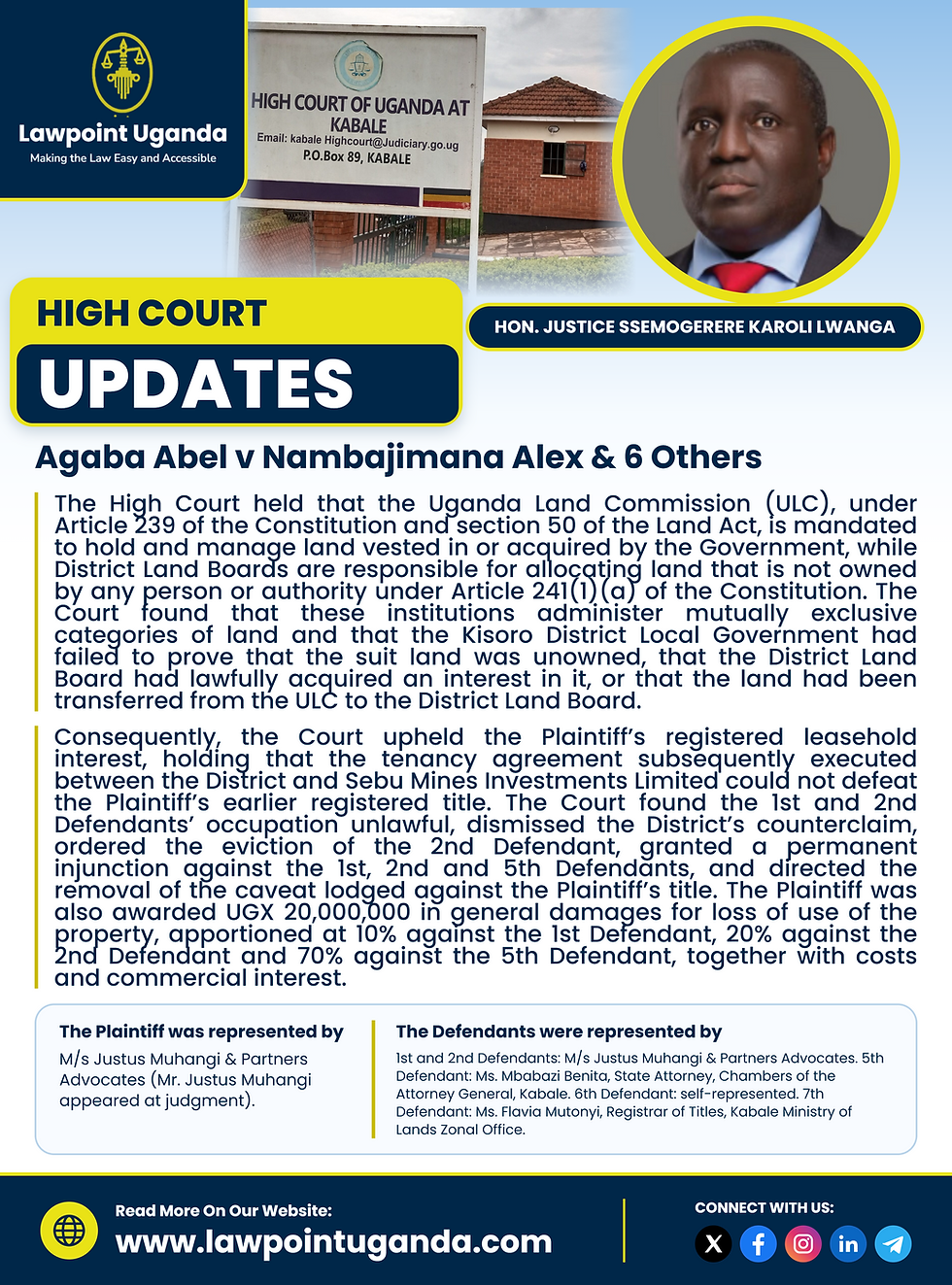
The High Court at Kabale held that the Uganda Land Commission (ULC) and District Land Boards administer mutually exclusive categories of land, and that a district local government which could not prove that land was "not owned by any person or authority" had no basis to claim it through a District Land Board. The Court upheld the title of a lessee holding under ULC, found the tenants who entered under the district's tenancy agreement to be trespassers, dismissed the district's counterclaim, and awarded UGX 20,000,000 in general damages.
Facts
The Plaintiff, Agaba Abel, instituted proceedings against seven defendants seeking, among other remedies, a declaration of ownership, a permanent injunction, eviction, demolition of allegedly illegal structures, general damages and costs of the suit in respect of land comprised in LRV 4737, Folio 15, Plot 2, Bunagana Road, Kisoro Road, together with Plots 5 and 7 registered on the same certificate of title.
The Plaintiff’s case was that the Uganda Land Commission (ULC), the 6th Defendant, had allocated the land to him pursuant to Minute No. 51/2017(a)(1), following a sitting held between 17 and 23 May 2017. He was initially granted a five-year lease commencing on 1 June 2018. Upon expiry of that term, the ULC granted him a further lease of 25 years on 12 October 2022, registered under instrument KAB-00002702.
The Commissioner of Land Registration, the 7th Defendant, confirmed that the Plaintiff was the registered proprietor of the suit property. The Plaintiff contended that he had placed a caretaker on the land, who subsequently left. In or around 2023, the 1st Defendant allegedly entered the property, deposited building materials and commenced construction without his consent. The Plaintiff complained to the relevant authorities, including the Town Clerk of Kisoro Municipality, seeking to stop the construction.
The dispute arose partly from a tenancy agreement executed on 4 June 2020 between Kisoro District Local Government, the 5th Defendant, and Sebu Mines Investments Limited, the 2nd Defendant. Under that agreement, the District purported to lease property described as including a two-bedroomed house and a compound along the Bunagana–Kisoro Road for a period of ten years. The 1st Defendant, who was a director of the 2nd Defendant and, at the material time, Vice Chairman of the District, maintained that the 2nd Defendant occupied the property lawfully under that tenancy agreement.
The 2nd Defendant further contended that the Plaintiff acquired his interest in the property after the company had entered into occupation. The 5th Defendant challenged the ULC’s authority to allocate the land to the Plaintiff, arguing that the property was government land under the management of the Kisoro District Land Board. It maintained that the ULC had acted unlawfully and sought to challenge the Plaintiff’s registered interest.
The ULC, on the other hand, maintained that the land was vested in or managed by it and had been lawfully allocated to the Plaintiff. Following a physical inspection, the Commission also disputed the District’s claim that the 2nd Defendant was a sitting tenant, observing that the property had been irregularly rented out without its consent and that there was no evidence that the company paid rent to the District.
The Commissioner of Land Registration confirmed that the Plaintiff’s interest was entered on the register and that the certificate of title reflected his leasehold interest.
During the proceedings, the 3rd and 4th Defendants withdrew from the suit by consent. The Court subsequently identified the central question as whether the ULC had lawfully dealt with the suit land.
Issues for Determination
Whether the Uganda Land Commission had lawfully dealt with the suit land.
The Court also considered preliminary objections raised by the 1st, 2nd, 6th and 7th Defendants concerning whether the suit disclosed a cause of action against them.
Legal Representation
The parties were represented as follows;
The Plaintiff was represented by M/s Justus Muhangi and Partners Advocates.
The 1st and 2nd Defendants was represented by M/s Niwagaba Advocates and Solicitors.
The 5th Defendant, Kisoro District Local Government was represented by Ms. Mbabazi Benita, State Attorney, Chambers of the Attorney General, Kabale.
The 6th Defendant, Uganda Land Commission was Self-represented.
The 7th Defendant, Commissioner of Land Registration was represented by Ms. Flavia Mutonyi, Registrar of Titles, Kabale Ministry of Lands Zonal Office
Submissions of the Parties
Plaintiff’s submissions
The Plaintiff maintained that the suit land had been lawfully allocated to him by the Uganda Land Commission and that his registered leasehold interest entitled him to protection against interference by the Defendants.
He contended that the 1st and 2nd Defendants were unlawfully occupying the property and undertaking construction without his consent. He sought recognition of his registered interest, eviction of the occupants, a permanent injunction, general damages and costs.
Counsel for the Plaintiff initially framed three issues for determination: whether the suit land lawfully belonged to the Plaintiff, the interests of the respective parties in the property, and the remedies available.
1st and 2nd Defendants’ submissions
The 1st Defendant denied having an independent interest in the land and raised a preliminary objection that the Plaintiff had not disclosed a cause of action against him. However, he was a director of the 2nd Defendant and had sworn an affidavit supporting a caveat lodged against the Plaintiff’s title on 20 March 2024.
The 2nd Defendant contended that its occupation was lawful because it derived its interest from the tenancy agreement executed with the 5th Defendant on 4 June 2020. It maintained that the Plaintiff acquired his interest after the company had already entered occupation and that it was therefore entitled to remain on the property.
5th Defendant’s submissions
Kisoro District Local Government challenged the ULC’s authority to allocate the suit land to the Plaintiff. It contended that the property was government land historically occupied or managed by the District and that it fell within the mandate of the Kisoro District Land Board.
The District relied on Article 241(1)(a) of the Constitution, which empowers a district land board to hold and allocate land in the district that is not owned by any person or authority. It also relied on Article 241(2) of the Constitution and section 61 of the Land Act, which address the independence and functions of district land boards.
The District argued that the ULC had acted illegally in granting the Plaintiff a lease over property that, in its view, was under the District’s management. It also sought to challenge the legality of the Plaintiff’s title and asserted that the 2nd Defendant’s occupation arose from a lawful tenancy agreement.
Uganda Land Commission’s position
The ULC maintained that the land had been lawfully allocated to the Plaintiff under its constitutional mandate to hold and manage land vested in or acquired by the Government of Uganda.
In correspondence to the District dated 15 March 2024, the Commission disputed the District’s claim that the land was under the control of the District Land Board. It further maintained that the District had irregularly rented out part of the property without the Commission’s consent.
Commissioner of Land Registration’s position
The 7th Defendant confirmed, upon examination of the register, that the Plaintiff was the registered proprietor of the land comprised in LRV 4737, Folio 15, Plots 2, 5 and 7, Bunagana Road.
The Commissioner’s position was that the Plaintiff’s leasehold interest was duly recorded and that the office’s role was to maintain the register and facilitate registration of interests in land.
The judgment recorded that the parties were directed to file written submissions, although compliance with that direction was partial.
Court’s Findings
The preliminary objections were dismissed
The Court first addressed the preliminary objections raised by the 1st, 2nd, 6th and 7th Defendants.
Regarding the 1st Defendant, the Court noted that he was a director of the 2nd Defendant and had sworn an affidavit supporting the caveat lodged against the Plaintiff’s title. The Court rejected the argument that the action against him should be dismissed merely because he acted in his capacity as a company director.
Justice Ssemogerere Karoli Lwanga observed that
“Directors don’t enjoy automatic immunity for actions taken as directors of private limited companies.”
The Court held that this finding was sufficient to dispose of the 1st Defendant’s preliminary objection.
The Court also rejected the 2nd Defendant’s objection that it was a lawful tenant of the 5th Defendant, reasoning that the legality of its occupation could only be resolved after consideration of the substantive dispute.
Similarly, the Court dismissed the 5th Defendant’s objection because the legality of the ULC’s dealings with the property was central to the proceedings. The 7th Defendant’s objection was also dismissed because the evidence held by the Commissioner of Land Registration was necessary to determine the validity of the Plaintiff’s registered interest and the competing claims.
The Court clarified the respective mandates of the Uganda Land Commission and District Land Boards
The Court held that the dispute turned on the distinction between land vested in or acquired by the Government and land that was not owned by any person or authority.
It examined Article 239 of the Constitution, which provides for the Uganda Land Commission to hold and manage land vested in or acquired by the Government of Uganda in accordance with the Constitution.
The Court also considered section 47 and section 50(a) and (c) of the Land Act, which operationalise the Commission’s functions, including managing government land and procuring certificates of title for such land.
In contrast, Article 241(1)(a) of the Constitution and section 61 of the Land Act provide for district land boards to hold and allocate land in their districts that is not owned by any person or authority.
The Court further considered regulation 23 of the Land Regulations, 2004, which distinguishes between applications for land held by a district land board and applications for land held by the Uganda Land Commission.
It was noted that the functions of the two institutions were distinct and that the District could not simply assert authority over land vested in the ULC without establishing a lawful basis for doing so.
The Court explained
“The district land board, only facilitates registration and transfer of interests in land, after allocating the same.”
The Court further observed that the applicable constitutional and statutory framework distinguished between land that was unowned and land vested in the Government.
The District Land Board’s authority over unowned land did not automatically extend to land already vested in or managed by the ULC.
The District failed to establish a lawful interest in the suit land
The Court noted that the 5th Defendant had not demonstrated that the Kisoro District Land Board had lawfully acquired authority to deal with the suit property. The District had not produced evidence of an application or allocation process under regulation 23 of the Land Regulations, 2004. Neither had it established that the property had been transferred from the ULC to the District Land Board.
The Court also found an inconsistency in the District’s position. In the tenancy agreement, it presented itself as the landlord and purported to lease the property to the 2nd Defendant. In its counterclaim, however, it asserted that it was merely a sitting tenant.
The Court held that the District had failed to establish either that the property was unowned or that the District Land Board had acquired a valid interest in it.
In considering the evidence required to establish an interest in land, the Court relied on Charles Bagalana and Others v Kigenyi Abdalla and Another, Civil Appeal No. 2 of 2023, [2025] UGHC 1513, which cited David Lwanga v Eria Muganga [1979] HCB 91 for the principle that title cannot be derived from a person who lacks a valid interest in the land.
The Court also referred to Watenga v Uganda Wildlife Authority and Others, Civil Suit No. 2 of 2014, [2021] UGHCD 195, in which the Court emphasised that a claim to ownership or inheritance of property must be supported by evidence.
Justice Ssemogerere Karoli Lwanga held that the District had not discharged that evidential burden. Its assertions that the land had historically been government property and that the District was a sitting tenant did not establish a lawful proprietary interest.
The ULC lawfully dealt with the land
The Court found that the District’s own pleadings described the property as government land. That admission undermined its argument that the land was unowned and therefore subject to allocation by the District Land Board.
The Court held that the ULC had authority to deal with the property under Article 239 of the Constitution and the relevant provisions of the Land Act.
It consequently answered the principal issue in the affirmative, finding that the Uganda Land Commission had lawfully dealt with the suit land.
The Court further found that the District had not established the affirmative acts, omissions or concealments necessary to prove fraud in the ULC’s dealings with the property. In this respect, it considered Fredrick J.K. Zaabwe v Orient Bank Ltd and Others, Civil Appeal No. 4 of 2006, [2007] UGSC 21, which discussed the essential character of fraud.
The Court observed that the District’s mistaken belief about the institution responsible for managing the property did not, without supporting evidence of fraudulent conduct, establish fraud.
The Plaintiff’s registered title was protected by law
The Court noted that the Commissioner of Land Registration had confirmed that the Plaintiff was the registered proprietor of the suit land. The Plaintiff’s interest had been entered on the register in 2022 following the grant of the further lease by the ULC.
The Court considered section 59 of the Registration of Titles Act, which protects a certificate of title from impeachment on account of informality or irregularity, subject to the applicable legal exceptions.
The relevant provision states
“Every certificate of title issued under this Act shall be received in evidence of the particulars set forth in the certificate as the proprietor of … the land….”
The Court held that a certificate of title is recognised as evidence of the particulars recorded in it and of the registered proprietor’s interest, unless the title is lawfully impeached.
It noted that fraud was the basis upon which a certificate of title could be voided under section 76 of the Registration of Titles Act. In the present case, the District had failed to establish the alleged fraud.
The Court therefore affirmed the Plaintiff’s registered leasehold interest.
The tenancy agreement could not defeat the Plaintiff’s earlier registered interest
The Court noted that the Plaintiff’s initial lease commenced on 1 June 2018, whereas the tenancy agreement between the 5th and 2nd Defendants was executed on 4 June 2020.
The Plaintiff’s interest had therefore been entered on the register before the tenancy agreement was executed. The Court held that the Plaintiff’s registered interest constituted constructive notice to persons who might subsequently seek to acquire an interest in the property. It observed that the 1st and 2nd Defendants ought to have undertaken a title search before entering into the tenancy arrangement with the District.
In this regard, the Court relied on Bernard Byamukama v Paul Muwanga t/a Polo Boutique, Civil Suit No. 477 of 2022, [2025] UGHC 261, in which the Court explained:
“Proving constructive knowledge involves showing that the person was aware of circumstances that would lead a prudent individual to question the situation and potentially uncover the truth.”
The Court faulted the 1st and 2nd Defendants for failing to conduct due diligence before entering into the tenancy agreement, particularly when the District asserted ownership without producing proof of title.
It held that the tenancy agreement could not defeat the Plaintiff’s earlier registered interest.
The 1st and 2nd Defendants were unlawfully occupying the land
Having found that the ULC lawfully allocated the land to the Plaintiff and that the Plaintiff held a valid registered interest, the Court concluded that the 1st and 2nd Defendants had no lawful basis to remain on the suit property.
The Court further found that the 5th Defendant had not established a lawful claim to the land. It consequently held that the Plaintiff’s action succeeded and that the District’s counterclaim failed.
The Plaintiff was entitled to UGX 20 million in general damages
The Court considered the Plaintiff’s claim for general damages arising from the unlawful occupation and loss of use of the property. It noted that the Plaintiff had not led specific evidence quantifying the loss suffered. However, the Court found that the period during which the Plaintiff had been deprived of the use of the property was approximately three years from 2023.
The 2nd Defendant had admitted occupation of the property in its amended written statement of defence. The Court therefore found that an award of general damages was justified to compensate the Plaintiff for the loss of use.
The Court held that;
“I find an award of UGX 20,000,000 (Twenty million shillings only) in general damages appropriate in the circumstances to compensate the plaintiff for loss of use.”
The Court apportioned liability for the award among the 1st, 2nd and 5th Defendants as follows;
10% against the 1st Defendant;
20% against the 2nd Defendant; and
70% against the 5th Defendant.
The award was intended to compensate the Plaintiff for the loss of use of the property during the period of unlawful occupation.
General damages
The Court acknowledged its discretion to award general damages, citing William Fred Kisembo and another v Kiiza Rwakaikara Kisembo Gunn. It noted that no specific evidence of loss was led, but that the period of deprived use was about three years from 2023 and that the 2nd defendant admitted occupation at paragraph 3(c) of its amended defence. It found an award of UGX 20,000,000 appropriate to compensate the plaintiff for loss of use.
Holding
The Court answered the sole issue in the affirmative, holding that ULC had authority to deal in the suit land. It held that the plaintiff's action succeeded, that the 1st and 2nd defendants and their agents were unlawfully on the suit land, and that the 5th defendant had no lawful claim to it.
Orders
The preliminary objections by the 1st, 2nd, 6th and 7th defendants that the suit disclosed no cause of action against them were struck out.
The plaintiff was declared the registered proprietor of the suit land, as prayed.
The 5th defendant's counterclaim was dismissed.
A permanent injunction was granted against the 1st, 2nd and 5th defendants from obstructing the plaintiff's use of the suit land.
The 2nd defendant was ordered evicted from the suit land.
The 7th defendant was ordered to remove the 1st defendant's caveat against the plaintiff's interest.
General damages of UGX 20,000,000 were awarded against the 1st, 2nd and 5th defendants, recoverable as 10% from the 1st defendant, 20% from the 2nd defendant and 70% from the 5th defendant.
The plaintiff was awarded costs of the suit.
Interest was awarded on orders 7 and 8 at the commercial rate.
The Court's Closing Comment
The Court commented on the history of ULC, noting that the 1995 Constitution "did not direct automatic transfer of land held by the Uganda Land Commission to the District Land Boards", and that the two bodies share a policy ministry but "manage mutually exclusive land". It concluded that land "must formally be transferred to the District Land Boards, in all other cases to be lawfully dealt with."
Read the full case
Key Takeaways
A District Land Board may only allocate land "not owned by any person or authority". Land vested in or held by Government is managed by ULC. A local government cannot assume its land board's jurisdiction over government land without a formal transfer from ULC.
Public bodies must prove their interest with evidence. Bare assertions of ownership, in pleadings, petitions or tenancy agreements, do not suffice.
The principle that title cannot flow from one who lacks a valid interest was applied to defeat a 10-year tenancy.
Entry on the register is constructive notice. Tenants and prospective tenants who skip a title search before taking possession may be treated as having constructive knowledge of the registered proprietor's interest.
Under section 59 of the Registration of Titles Act it can be impeached only for fraud under section 76, and fraud requires proof of positive, intentional acts. An honest but mistaken belief is not fraud.
A director who personally lodges a caveat or acts on the company's behalf may be sued directly in trespass.
A caveat resting on a defective interest was ordered removed.
Government entities are not exempt from costs and damages, The 5th defendant bore the largest share of damages (70%).


Comments