
Court of Appeal Clarifies Evidentiary Requirements for Local Government Claims to Pre-Independence Customary Land and Addresses Effect of Locus in Quo Irregularities

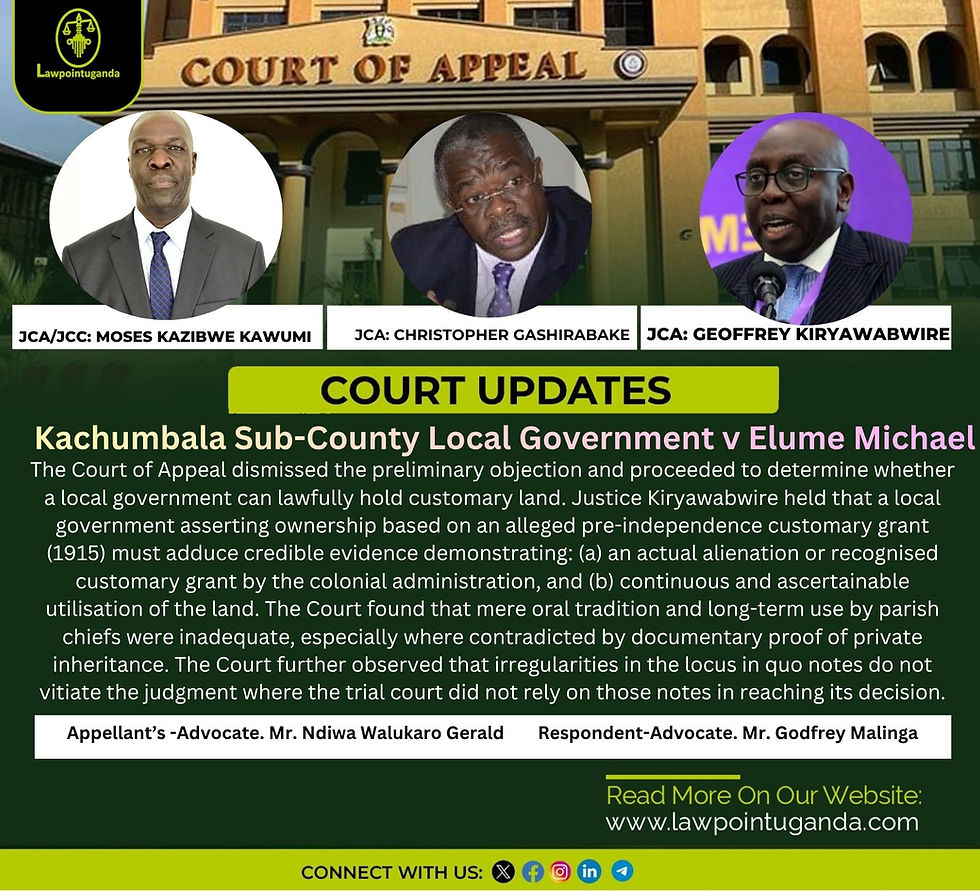
FACTS
This matter arose from a land dispute over approximately nine (9) acres located in Kotia, Kachinga Village, Kachumbala Sub-county, Bukedea District.
The Appellant (Local Government) claimed customary ownership dating back to 1915, asserting it received the land from Agoloi Kosafa and that various parish chiefs had been in possession until 2005, when the Respondent allegedly trespassed.
The Respondent claimed inherited customary ownership from his late father Amuya Emmanuel in 1974, asserting uninterrupted occupation until 2007, when his crops and house were allegedly destroyed by the Appellant’s agents.
Procedural history:
The Chief Magistrate’s Court at Bukedea held that the Appellant was the customary owner.
On first appeal, Hon. Lady Justice H. Wolayo (High Court, Soroti) reversed the decision, holding that the Appellant had failed to prove its case on a balance of probabilities.
The local government filed a second appeal to the Court of Appeal.
ISSUES
Whether the High Court Judge relied on an incomplete, unsigned, unsealed and uncertified record of proceedings.
Whether the first appellate Judge failed to subject the evidence to fresh and exhaustive scrutiny.
Whether the Judge relied on the sketch map from the locus visit but ignored the oral testimony given at locus.
Whether the Judge erred in holding there was no evidence of possession by the Appellant.
Whether the Judge denied the Appellant a right to be heard.
Whether the Judge set aside the trial magistrate’s decision without reasons or reference to evidence.
SUBMISSIONS
Preliminary Objection – Respondent
Argued the Appellant, being a corporate entity, cannot own customary land, citing Hard Rock Quarry (U) Ltd v CLR.
Asserted the Appellant failed to demonstrate lawful acquisition of land in 1915, a time governed by the Crown Lands Ordinance of 1903, requiring a lease from the Governor for legal occupation.
Appellant’s Response
Argued customary tenure reference was merely historical context, not the main issue on appeal.
Asserted that the objection was never pleaded, never raised at trial, and cannot arise for the first time on second appeal.
Argued that government entities can receive land from customary owners, citing Mugambwa’s Principles of Land Law in Uganda.
LEGAL REPRESENTATION
Appellant, Mr. Ndiwa Walukaro Gerald
Respondent, Mr. Godfrey Malinga
COURT’S FINDINGS
Preliminary Objection
The Court rejected the objection:
“This objection arises for the first time in the Respondent’s submissions in reply and lacks both factual and legal foundation… it does not meet the threshold of a preliminary objection as laid down in Mukisa Biscuit.”
“A preliminary objection must raise a pure point of law which is apparent on the face of the pleadings and capable of disposing of the matter without resorting to evidence – Mukisa Biscuit Manufacturing Co. Ltd v West End Distributors Ltd [1969] EA 696.
The issue of whether a government entity can own or receive land under customary tenure was neither pleaded nor raised at trial or in the first appeal… This objection arises for the first time in the Respondent’s submissions in reply and lacks both factual and legal foundation in the proceedings… Accordingly, the preliminary objection is overruled and dismissed with costs in the cause.”
Ground 1 – Uncertified / incomplete record
Justice Kiryabwire acknowledged the importance of certification but held:
The incomplete locus proceedings were immaterial, as the High Court did not rely on them.
The sketch map did not prejudice the Appellant.
He noted:
“It is clear to my mind that the locus visit played no role in determining ownership of the suit land…”
The Court noted the absence of typed locus proceedings but held that the High Court Judge did not rely on them and that no prejudice was caused.Crucial finding on ownership (High Court judgment upheld):
The Court of Appeal quoted and endorsed the High Court’s core conclusion (at p. 63 of the Record of Appeal):
“…in the absence of credible evidence of the existence of Kotia parish in the 1980s and the absence of documentary evidence that the suit land was alienated by the colonial government and in absence of credible evidence that Chiefs utilized the suit land, I find that the respondent [local government] failed to prove its case on a balance of probabilities…”
Ground dismissed.
Ground 2 – Failure to re-evaluate evidence
The Court held the Judge properly re-evaluated the evidence. At page 62 of the record, the Judge explicitly found:
“I am satisfied with the evidence of the appellant that he inherited the suit land from his late father … Dexh.1 … was not challenged in cross-examination.”
Justice Kiryabwire noted this was a question of fact, which the Court of Appeal cannot revisit unless unsupported by evidence, per Kifamunte v Uganda.
On re-evaluation of evidence (Ground 2 – failed):
The Court of Appeal found that the High Court had subjected the evidence to fresh scrutiny and accepted its conclusion that the Respondent had proved inheritance:
“…I am satisfied with the evidence of the appellant that he inherited the suit land from his late father Manei Amuga in 1974… It is this document [Dexh. 1 – letters of administration/heir appointment] that is the basis of the appellant’s claim to the suit land as it appoints him heir and names him and a sister as the only children of the deceased Maneri…”
Ground dismissed.
Ground 3 – Reliance on sketch map
Addressed together with Ground 1. Since the sketch map was used only to understand the site layout and not to prove ownership, no error occurred.
Ground dismissed.
Ground 4 – Evidence of possession
The Court found this ground hinged on factual evaluation already settled under Ground 2.
Ground dismissed.
Ground 5 – Right to be heard
The Court held:
“This Ground was not argued… [and is] deemed abandoned.”
Ground struck out.
Ground 6 – Miscarriage of justice without reasons
The Court found this ground duplicated earlier issues (Grounds 1–2) and was therefore a duplex ground, which is improper.
“Such duplex grounds are an abuse of Court practice…”
Ground dismissed.
HOLDING
The Court of Appeal held:
All grounds of appeal fail.
High Court judgment upheld.
Respondent confirmed as the customary owner of the suit land.
Costs awarded to the Respondent both in the Court of Appeal and in the High Court.
KEY TAKEAWAYS
1. Second Appeals are restricted to questions of law.
The Court reaffirmed the principle from Kifamunte, factual findings are not revisited unless unsupported by evidence.
Corporate/public bodies and customary tenure:
The Court of Appeal declined to decide whether local governments can hold customary land, overruling the preliminary objection on procedural grounds (not raised below). The issue therefore remains open in Uganda.
Evidential burden in customary land claims by public entities is heavy:
A local government claiming pre-independence customary grant (1915) must produce credible evidence of (a) actual alienation by the colonial authorities or recognised customary grant and (b) continuous utilisation. Mere oral tradition and long use by parish chiefs was held insufficient when contradicted by documentary evidence of private inheritance.
Documentary evidence trumps oral history in conflicting claims:
The Respondent’s unchallenged letters of administration and clan minutes (1974) outweighed the Appellant’s unsupported assertion of a 1915 gift to a parish chief.
Procedural defects in lower court records will not automatically vitiate an appeal if no prejudice is shown and the appellate Judge did not rely on the defective portion (here, the irregular locus visit).
Second appeals are confined to questions of law:
The Court of Appeal reiterated Kifamunte Henry v Uganda (SCCA No. 10 of 1997) – it will not interfere with concurrent findings of fact unless there is no evidence at all to support them.
Practical implication for local governments:
Many sub-counties and parishes occupy land on the basis of alleged historical grants to chiefs. This decision signals that such claims are vulnerable when challenged by private claimants with succession documents. Local governments should urgently regularise such holdings (conversion to leasehold/freehold or obtaining certificates of customary ownership where permissible).
Read the full case below


.jpg)

Comments